Russia-Ukraine War: Two Cameroonians Fighting for Russia Captured by Ukraine
By Hans Ngala
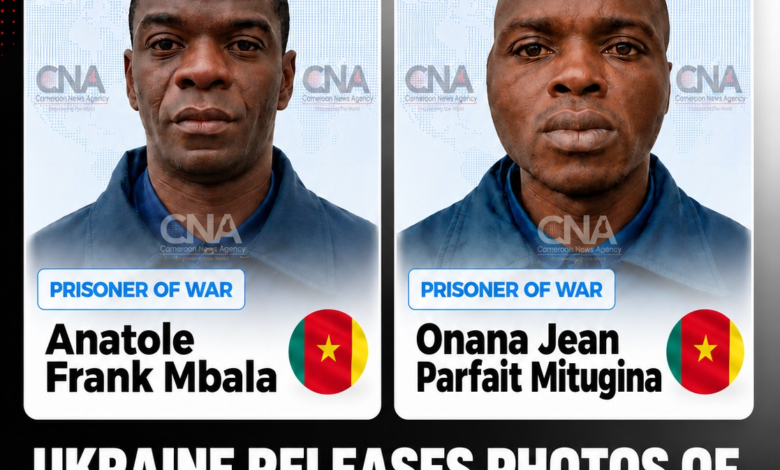
Ukrainian authorities have released the photos of two Cameroonian men captured on the battlefront in Ukraine while fighting for Russia. Onana Jean Parfaot Mitugina and Anatole Frank Mbala (born in 1999) are being held by Ukrainian authorities, CNA learned. Both men were captured by Ukraine since May 2025.
However, Cameroonian authorities have largely remained mute on the matter of the recruitment of its citizens into the Russian. They only acknowledged the death of 16 Cameroonians in April 2026. This tepid response, according to Franklin Sone Bayen, a respected Cameroonian journalist “With regards to communicating about the capture of these two Cameroonian combatants, they are an insignificant number compared to the over 4,000 Russian POWs held by Ukraine.
Does Russia report on every one of their POWs in Ukraine’s hands?” Bayen posits. He argues that “I would think it is more the business of Cameroon than Russia’s (to be concerned about the safety of Cameroonians). Let’s bear in mind that Russia has them as mercenaries (well except those who are taken out of Russian jails and forced to the battlefront without their consent). I won’t oblige Russia to report on mercenaries they are paying to do their dirty job”.
For Professor Victor Julius Ngoh, renowned Cameroonian historian and social critique, “The Cameroon government has good diplomatic relations with Russia and of course, the Yaounde government is aware of the fact that Cameroonians are being recruited to go and fight on behalf of Russia against Ukraine” Ngoh states.
“The high unemployment of youth in Cameroon and the increasingly poor politico-socio-economic environment puts the Yaounde government in a very uncomfortable position” Ngoh says. “The Yaounde government is silent on this issue in spite of the fact that it is an open secret that young Cameroonian lives are wasted fighting in a war whose cause and outcome most of them do not understand. Moscow, for its part, cannot publicly acknowledge that Cameroonians are being used by Russia like fodder in its war against Ukraine. And it not only Cameroonians, but also a good number of Africans from other African countries”.
So far, more than 100 Cameroonians have died on the frontlines of the war – the highest casualty rate of any African country according to INPACT, an international coalition of investigative reporters whose findings were published in February this year.
There is also an indication that Cameroonians are deceived into joining the Russian army. We cannot confirm if this deception happens at the level of recruiting agencies or if Russian authorities are aware of this. However, the stories of Dongmo Brice and Onana Moise clearly indicated elements of deception. Onana left Cameroon having been promised a job by an agent whose name his family gave us just as “Harrison” while Dongmo left Cameroon on a study visa, but both men ended up on the frontlines under circumstances that remain unclear to this day. Both men would lose their lives on the frontlines.
The most recent case of plausible deception involving a Cameroonian is that of Mevoungu Mbe Stevys Astride, according to the website StopRussianRecruiters.org – a designed to “document and disseminate information pertaining to the recruitment practices of the Russian Armed Forces”.
The 19-year-old Astride, an Under-17 international footballer who was told he was travelling to Russia for a trial with FC Ural ended up serving as a storm unit mortar operator according to StopRussianRecruiters.org
The organization lists over 28,000 foreigners in the Russian army with more than 5,000 foreign recruits having died fighting on behalf of Russia.
In May of 2026, Cameroon’s ambassador to Russia, Paba Sale, attended the International Security Forum hosted by Russian authorities in Moscow, but it is unclear if Sale brought up the issue of Cameroonians in the Russian and Ukrainian armies for discussion at the Forum.
The silence surrounding Cameroonians fighting and dying in Ukraine has become as consequential as the war itself. Behind every casualty is a family searching for answers, and behind every recruitment story lies a troubling mix of poverty, desperation, and unanswered questions. Whether these young men enlisted willingly or through deception, the Cameroonian state has a duty to protect its citizens, demand accountability, and provide transparent information. As diplomatic ties with Russia deepen, the growing human cost for Cameroon can no longer be treated as a peripheral issue. For grieving families, this silence from Yaounde, offers neither justice nor closure.