Buea Mountain: What safety means after earth tremor?
Nchendzengang Tatah
Safety concerns have gained prominence after an early-morning earth tremor on October 23 instilled perplexity and suspicion among Buea residents. Between 3 am and 4 am, residents in different parts of the town, spread out at the foot of the mountain, say they felt earth tremors lasting less than half a minute.
It is reported to have been significant enough to dangle kitchen utensils, shake beds and send dogs barking shortly after it. One resident recounts that “things were shaking in my house, even my bed. That scared me a lot; I didn’t go out for my usual sports at 5 am.”
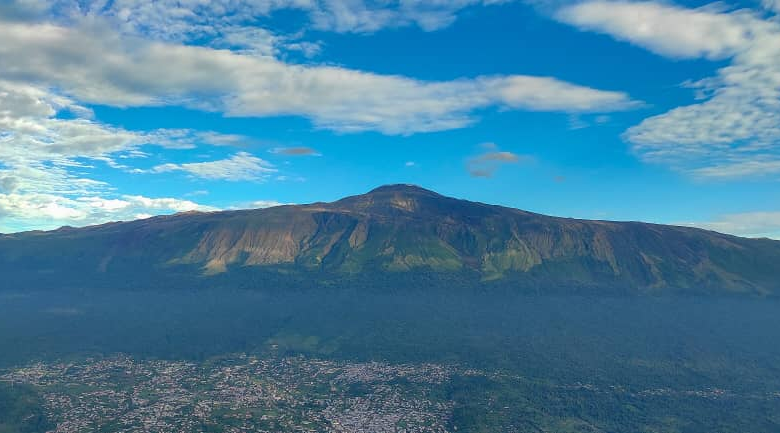
While it remains unclear exactly what this indicates, it is generally seen by experts as events that indicate natural phenomena beneath the earth crust. Even though official sources are yet to issue a definite statement, it has been largely linked to Mount Cameroon, an active volcano that last erupted in the year 2000.
Locals are beginning to worry about the fate of the city’s storey buildings they abide in. Raising questions about its resistance and impact on lives should a disaster hit the city. Many of these buildings have far exceeded the four-floor threshold current laws impose. Even though experts argue that the real trouble lies with the quality of work done.
Eric Ndive Kulu, the chief of Technical Services at the Buea Council, who is an expert in disaster risk management, holds “Building Permit” as an indispensable factor in strengthening building construction to meet technical safety requirements. He further warns that these permits must be matched with the practicals during construction to have enduring structures.
Kulu said those who had already built against the norms had hope. That was to engage professional help to strengthen structures at a cost. He was speaking on October 24 on the invitation of the traditional ruler of Bokwoango, Chief Albert Njie Mbonde, as part of efforts to sensitise community members, especially storey building owners.
By and large, local efforts may not replace state response, which Senator Mbella Moki, a son of Buea, says he has upon himself to outline to the ministries concerned during the November Session of the Senate in Yaounde. Having been caught up by the tremor in his Likoko Membea residence while at prayer, the Member of the Upper House of Parliament says it is incumbent upon him to translate the feelings he had to decision makers.
Mount Cameroon is home to several species of protected animals and plants. It is the stay of “Epassa Moto”, whom the Bakweri settled at the slopes believe to be the god of the mountain. “We are the mountain, the mountain is us,” says Chief Albert Njie Mbonde of Bokwoango, a central village to the mountain’s myths. Explaining that the phenomenon was not strange to them as age-old custodians, he reiterated the need for planning to monitor and respond to changes as they come.
The traditional ruler admonished that awareness raising must replace panic with an intensification of the defence mechanism through monitoring. “We count on everybody to be on the watch,” he has told his villagers.
The last time the chariots of the gods were seen in 2000, it is documented to have approached within 4 kilometres of Buea. The largest seismic event recorded during this period had a magnitude of 4, as profiled by the Journal of Volcanology and Geothermal Research, 2009. This was following an earlier eruption in 1999.