The Anglophone Conflict and the Race for the Next UN Secretary-General: Does Macky Sall Offer a Prospect for Peace?
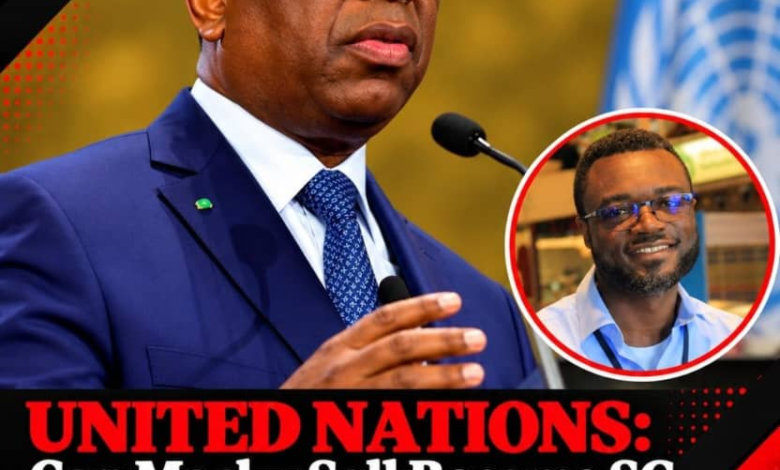
By Hans Ngala
As the United Nations prepares to appoint its tenth secretary-general, the contest to succeed António Guterres could have important implications for Cameroon, where the armed conflict in the North-West and South-West regions continues to challenge national stability and international efforts to promote peace.
The next secretary-general takes office on January 1, 2027, inheriting an organisation now grappling with geopolitical tensions, shrinking funding and escalating conflicts. For Cameroon, the leadership transition raises a critical question: could a new UN chief revive international efforts to resolve the Anglophone Conflict given how poorly Guterres handled it?
Seven candidates remain in the running, four of them women. This follows the withdrawal of former Chilean president Michelle Bachelet’s nomination. The informal expectation of regional rotation favours Latin America and the Caribbean, but Macky Sall, Senegal’s former president, remains a contender whose candidacy deserves attention in West-Central Africa.
The Anglophone conflict: A test of UN diplomacy
Cameroon’s Anglophone conflict emerged from longstanding grievances over the political, legal and educational marginalization of its English-speaking population. Protests by lawyers and teachers in 2016 escalated into an armed conflict following the government’s brutal crackdown – leading to an armed uprising that has persisted to this day.
Since 2016 civilians have endured killings, displacement, school closures, kidnappings and destruction of their livelihoods. Government security forces and armed separatist groups have both been implicated in abuses against civilians, while communities continue to bear the consequences of a crisis that has resisted repeated calls for peace.
International efforts have struggled to produce a lasting political settlement. Switzerland facilitated contacts between the government and separatist representatives from 2019, but the process stalled amid disagreements and Yaoundé’s withdrawal. Canada also announced that they were willing to mediate but Yaounde denied knowledge of any such mediation efforts.
The UN has repeatedly called for dialogue and reconciliation. In September 2017, then Secretary-General António Guterres urged the Cameroonian authorities to address Anglophone grievances and stressed that genuine, inclusive dialogue was essential to a durable solution. He also reaffirmed support for Cameroon’s unity and territorial integrity. Yet public appeals have failed to produce a comprehensive peace process capable of bringing the two warring parties to sustained negotiations.
The next secretary-general’s significance will therefore lie less in issuing another statement of concern and more in determining whether the UN can help create conditions for meaningful dialogue. Such efforts must address the form of governance in the NW and SW regions, political representation of both regions, acknowledge their historical grievances and the future of the Anglophone regions while including separatist leaders and groups currently in Europe, North America and South Africa.
Macky Sall’s candidacy: Does he stand a chance?
Sall entered the race with Burundi’s backing, having been formally nominated on March 2, 2026. The former Senegalese president led his country for twelve years and served as African Union chairperson in 2022. His campaign has emphasized preventive diplomacy, multilateral cooperation, institutional reform and the relationship between peace and development.
These credentials could appeal to governments seeking a secretary-general with experience in African politics and negotiations between national leaders.
However, Sall faces considerable obstacles. The informal regional expectation favours Latin America and the Caribbean, while growing calls for the UN to appoint its first woman secretary-general strengthen the position of female candidates. Ultimately, a candidate must secure sufficient Security Council support without opposition from any of its five permanent members.
On October 7, Reuters reported that Costa Rican candidate Rebeca Grynspan had emerged as the leading candidate in an informal Security Council poll, receiving nine votes in favour and six against. The contest remained unsettled, but the report offered no indication that Sall was the frontrunner.
Sall’s candidacy is therefore viable but faces an uphill contest. His prospects depend on changing Security Council preferences, the emergence of a consensus candidate and whether influential states are willing to depart from the informal regional expectation.
For Cameroon, however, the eventual secretary-general’s willingness to devote diplomatic attention to the Anglophone conflict may matter more than their geographical origin.
What should Cameroon expect from the next UN chief?
Cameroon should not assume that appointing a new secretary-general will automatically transform the international response to the conflict in its NW and SW regions. The office’s influence is constrained by Security Council divisions, member-state interests and the willingness of conflict parties to cooperate.
The incoming leader will also face competing demands, including bigger wars like those in Gaza and Ukraine, climate emergencies, reduced funding and institutional reforms.
Cameroon must therefore make a compelling case for sustained international engagement.
Biya’s government could work with the new secretary-general to explore an inclusive political process, while armed separatist groups would need to demonstrate a willingness to protect civilians and participate in negotiations capable of producing a sustainable settlement.
A new secretary-general, a new opening for peace?
The race to succeed Guterres presents Cameroon with an opportunity to reconsider how the international community can support a peaceful resolution to the Anglophone conflict.
Macky Sall could bring African diplomatic experience, an emphasis on preventive action and a development-oriented understanding of peace. But his candidacy faces political obstacles, and there is currently no evidence to conclude that he would prioritize Cameroon or adopt a fundamentally different approach from his predecessors, in other words, he is likely to be exactly like Antonio Guterres with regards to the conflict in the NW and SW.
The decisive question is whether the next UN leader—Sall or another candidate—will move beyond verbal expressions of concern and move to create conditions for sustained, inclusive negotiations.
For people living through the conflict in the North-West and South-West, success will not be measured by the nationality or gender of the person occupying the UN’s highest office. It will be measured by whether international diplomacy helps reduce violence, address longstanding grievances and establishes a credible path towards peace.
The next secretary-general cannot resolve Cameroon’s conflict alone. But the office could help determine whether international diplomacy remains on the margins or becomes a more effective instrument for supporting a negotiated settlement.