By Nchendzengang Tatah
This is August 21, 1986, after a busy market day in the Nyos Valley of Menchum Division, North West region. The green virgin landscape is still, as usual, with families dining, heading to bed, or counting their days’ fortunes. Amongst them is Suleman Abuobakar, who will later become one of the survivors of the Lake Nyos disaster: a deadly release of approximately 1.6 million tons of trapped carbon dioxide gas from the lake’s bottom in a limnic eruption.
The Government Primary School Old Town Bamenda teacher today, Suleman, then a sixteen-year-old primary five pupil, was in one of three original settlement areas of Nyos. Here, almost on a hilltop, he remembered, in an exclusive interview on CRTV Bamenda with Colday Olivier, a troubling sound made its way through the community at about 8:30 pm. He later heard that the water had risen in volume and rocks falling into it may have burst a balloon of unfriendly gases. He feels that the gaseous air had taken more time to climb to his height, even though he believed it was intercepted by the consumption of red oil from ruining them like those he heard scream from lower altitudes.
Another victim, Prudencia, pregnant at the time, recalled in a CRTVweb production how the earth trembled through that evening as the water body vomited the deadly gas. Her husband would later tell her that the lake had increased in quantity and burnt down the greenery around it. He was on his way to deliver honey to a family relation around the lake when he came across the scene.
Official reports account the human deaths to 1746, with over 3000 livestock killed. Yet, Suleman is convinced these are only for those counted, of which many more persons may have been out of reach. He even fears the death toll will have been worse if the local muslim cleric hadn’t banned late-night partying in the community as part of the Muslim feast locally called “Sallah”, pushing many young Muslims to travel to Esu for festivities.
Suleman still recalls the intervention of a catholic priest after the disaster before government agents could access the vicinity.
The incident had caused the government to immediately relocate the remnants of Nyos, amongst whom was Suleman, before seven camps were later constructed. Here, education and health were provided through primary schools and health centres. Furthermore, Suleman was a beneficiary of a scholarship by the government that lasted three years, together with food support, until the victims were permanently settled in earmarked camps from 1989, according to his narration.
The assistance the survivors received was equally from non-governmental organisations and faith-based groups who rose to the occasion.
Years have gone by, but the wounds of the disaster have remained wide. Fatima Musa and Dradawu, both daughters of survivors born twenty years later, have grown not only to listen to the unforgettable episode but to witness a devastated family tree reviewing their account on CRTV Bamenda. Fatima will have only her dad survive out of a family of eighteen. He had enjoyed “Sallah” in Esu and narrowly escaped the incident. Prudencia, now advanced in age, had lost her husband two years after the incident. She has since then neither had a husband nor family to relate with except her birthed child.
Fatima believes the Lake Nyos incident is not just history, but a call for continues sensitization inorder not to have the same incident again. Likewise, Dradawu hopes that the fortieth anniversary will inspire hope and support in the journey towards recovery.
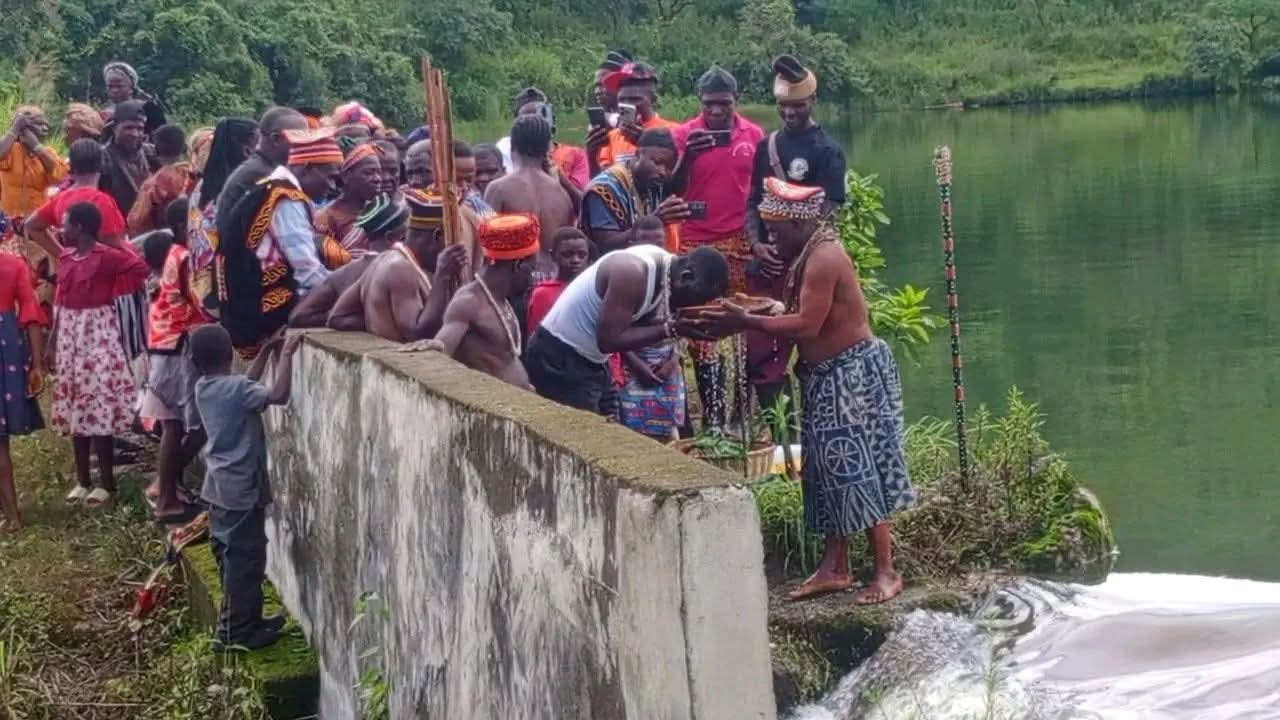
This fortieth anniversary of remembrance is not going unnoticed. Under the guidance of the traditional ruler of Nyos, Fon Richard Kimbi Chuh, the world’s attention is being drawn to honour the memory of the victims and discuss the future of the survivors. Weeklong celebrations will culminate on August 21 see their summit with a ceremony in Nyos, which has already tilted national media discussions.
The Lake Nyos Day of Remembrance will this year be inspired by the theme: “Resilience and Sustainable Development of Lake Nyos Basin.” Fon Kimbi may not have witnessed the tragic event firsthand, but relying on Fulani accounts as disclosed on CRTVweb, a circular accumulation had dashed from the lake unto the sky. He asserts that a mysterious voice in the indigenous language had ordered the water and its contents to drive down the valley.
His late Uncle, the Fon at the time, had, following the incident, relocated to Bafmeng like many of his people until it was clear that the Nyos area was safe.
He insists that life is yet to fully take its pace like before the disaster in Nyos. The case is so because returnees are starting afresh, building from almost nothing while wrestling with the scars of memories.