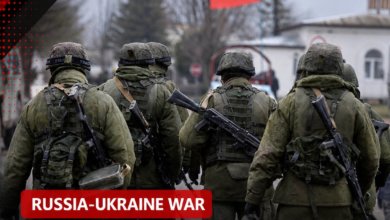
Russia-Ukraine War: The Economics Pushing Cameroonians to the Frontlines
An investigative report by Hans Ngala
The name of the recruiting group is Rhema Group Travel, and the travel agency claims to assist with visas to Lithuania, Albania, Cambodia, New Zealand, and even Russia. While the company has no official website, it owns a Facebook page called Rhema Group Travel. The name itself is telling: Pentecostal symbolism mixed with promises of overseas travel. “Rhema” is a word in Pentecostal Christian theology that believes that the “rhema” is God’s spoken word to a believer. The company seems to suggest that God speaks to Cameroonians who use them and guarantees their travel to Western or Asian countries for a better life.
The context is especially significant. Cameroon’s unemployment rate stands at 39.3% of young Cameroonians (ages 15-35) unemployed according to the International Organization for Migration (IOM). Most university graduates are unable to find work, leaving many with the belief that they can only succeed overseas. Travel companies see this desire by Cameroonians to seek greener pastures across oceans, then capitalize on this and cash out on it. Visas are promised for a fee once applicants submit their documents. A review of the visa fees charged by Rhema Group ranges from 450,000 CFA (809 USD) to 3.5 million CFA or about 6,200 USD for visas to Dubai. The group has two numbers: a WhatsApp number based in North America, based on the country code, and a local Cameroonian number for direct calls.
The company is specifically mentioned in the All Eyes on Wagner (AEOW) report published on 11 February 2026.
The report is the first comprehensive report of its kind to document the recruitment of Africans and the deaths of Africans on the frontlines in Ukraine. According to the report, Cameroon recorded the highest number of deaths, 94 in total. This figure goes up to 95 when Nkami Watat Serge Christian is added to the list. Nkami Watat is listed as an Algerian, but the document says “probably Cameroon”. Our investigations can confirm that Nkami Watat is a common surname in Francophone Cameroon, and we believe that the 49-year-old was a Cameroon-born man who may have held an Algerian passport too.
Our search online for Nkami Watat Serge Christian turned up a Facebook profile named Serge Christian Kami Watat. A local number listed under the profile was also not available. There was no Russia-related content under the profile, and CNA could not confirm if this was the same person named in the All Eyes on Wagner report. The Facebook profile was, however, last active on March 14, 2024.
The numbers have risen steadily since the invasion of Ukraine: 177 African recruits in 2023, 592 in 2024, and 647 in 2025. The average recruit is just 31 years old. Fifty-one were killed within a month of deployment. Many were assigned to high-casualty units such as Russia’s 7th Independent Motorized Rifle Brigade.
The Economics Behind Cameroonians Fighting for Russia – And Ukraine
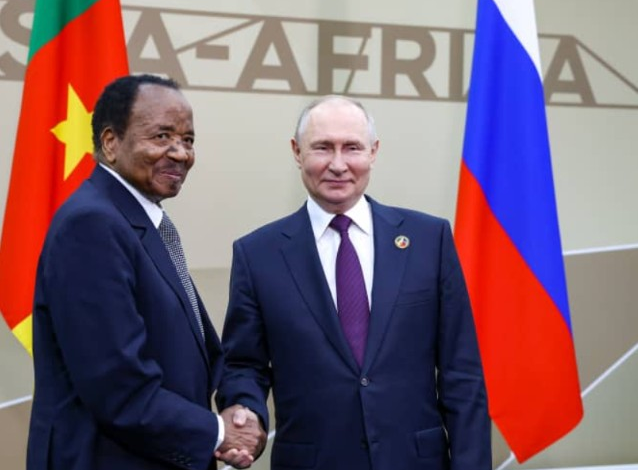
Behind these statistics lie a deeper structural failure at home. President Paul Biya,93, in power since 1982, presides over a country where youth unemployment and underemployment remain chronic. According to the National Institute of Statistics, Cameroon’s broad unemployment and underemployment rate among young people remains alarmingly high, with many graduates trapped in informal or precarious work. For thousands, the promise of a visa represents not just travel, but escape from the collapse and hopelessness being presided over by Biya.
Recruitment networks exploit this desperation. African Digital Democracy Observatory describes a “layered ecosystem” linking Russian operatives, diaspora fixers in Moscow, and local travel agencies across West Africa. In Cameroon, Rhema Group Travel is singled out as a key conduit, as pointed out earlier in this report. Though advertising visas to Canada, the UAE, Bulgaria, and Russia, several of its clients reportedly ended up on the Ukrainian frontlines. The company’s offices are listed in a neighborhood of Yaounde, which we visited, but couldn’t find the building. We are not sure if the owner or owners of the company pose as preachers. A good number are known to own churches or “ministries” and use their religious standing to promise divine breakthrough or travel to congregants – essentially exploiting them for financial gain.
The Stories Behind the Names
CNA remains the leading newsroom in Cameroon in terms of coverage of the Russia-Ukraine War and its fatalities. Before All Eyes on Wagner released its February 11 report, we had identified two victims who appeared on that list. We had documented the story of Dongmo Brice, who left Cameroon on a study visa but wound up on the frontlines, where he was killed. His family is not sure which travel agency processed his documents. Brice had been struggling financially in Cameroon, working as a salesperson for a telecommunications company.
Onana Moise Roger had a relatively stable income from his job with a company in Douala, the economic capital of Cameroon. According to his mom, a travel agent whom she only identified as Harrison, convinced her only son, Onana, to travel to Russia, promising him he’d get better pay there. Onana was killed shortly after arriving in Russia. According to his mother, he only sent money from his salary as a Russian fighter once and was never heard from again.
Based on the list published by INPACT’s All Eyes On Wagner, we identified three more Cameroonians. Mainimo Franklin was 34 and had been working as a taxi driver in the capital city, Yaounde. He had three kids and a wife and was convinced that a higher salary with the Russian army would help him take care of his family. He was killed in 2025, but his family only found out months later when his name appeared on the list of Africans killed on the frontlines.
Nges Didymus was a rising businessman whose sales in office stationary was doing well. However, it is unclear how he wound up in Russia. His family was too stunned to talk to our reporters following the publication of the INPACT list of Africans killed. Nges’ name appeared on the list. His family hadn’t heard from him for months in 2025 – leading to suspicion that he had been killed in Russia several months ago.
Mbah Placid was a soldier serving with the Cameroon army. He is one of over 100 Cameroonian soldiers to defect and join the Russian and Ukrainian armies. He left for Russia in 2024, and by February 2025, his phone was unreachable, according to a friend of his whom CNA spoke to. His name appeared on the list by INPACT, leading to suspicion that he had been killed almost a year to the date INPACT’s list was published.
Military Personnel Are Especially Targeted
Beyond civilian recruitment, Russia has strategically targeted weaknesses in Cameroon’s military. Cameroonian soldiers earn meager salaries while battling Boko Haram in the Far North and separatist insurgents in the Anglophone regions. AEOW notes that Russia offers salaries up to ten times higher than what Cameroonian soldiers earn at home. The South Africa-based Institute for Security Studies (ISS) in Pretoria confirms this. According to the ISS, specialists such as snipers from African countries are promised salaries as high as 3,000 USD per month. This is equal to about 2.6 million CFA, which most soldiers are unable to make in a year on their current salaries. The result is desertions that Yaoundé treats as a disciplinary crisis rather than a symptom of deeper economic malaise.
The story mirrors patterns elsewhere. Authorities in Togo, Kenya, and South Africa have publicly acknowledged similar recruitment schemes. President Cyril Ramaphosa of South Africa called Russia’s Vladimir Putin, and Putin facilitated the return of some South African men who were lured to fight in Ukraine. Cameroonian authorities have declined to comment on the deaths of its citizens in Ukraine, despite Cameroonians having the highest death toll on the frontlines in Ukraine. Cameroon’s combination of economic stagnation, prolonged political hegemony under Biya, and limited employment prospects for youth has made it uniquely susceptible to Russian recruitment.
For many young Cameroonians, the journey begins with a visa application and ends in a trench in eastern Ukraine. What appears at first glance as a foreign entanglement is, at its core, a domestic failure. As long as economic opportunity remains scarce and governance remains stagnant, Russia’s recruiters will continue to find willing — and desperate takers.