Rigour, Moralisation and Integrity: The Broken Promise of Paul Biya’s Presidency
By Wilson Musa
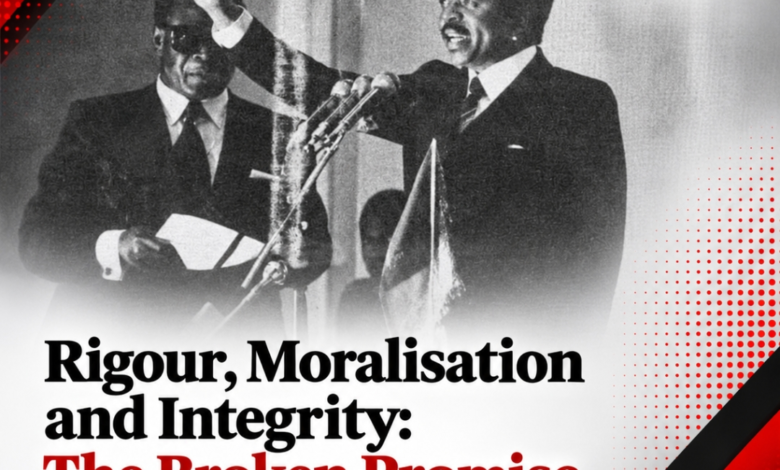
When Paul Biya assumed power on November 6, 1982, he presented a new vision of governance built around three principles: rigour, moralisation and integrity.
The message suggested a departure from the excesses of the past and a commitment to discipline, accountability and responsible management of public resources.
Forty-four years later, however, the record of his administration raises serious questions about how far those principles have been implemented.
Over eight presidential mandates, corruption scandals, allegations of embezzlement and the mismanagement of public resources have repeatedly implicated senior officials appointed under his administration.
The launch of Operation Sparrowhawk (Opération Épervier), an anti-corruption campaign that began in 2006, initially appeared to signal a determination to confront corruption within government.
But the campaign also attracted criticism. Some observers questioned whether it represented a genuine institutional fight against corruption or was being used selectively against political figures who had fallen out of favour or were perceived as potential political challengers.
While several senior officials were prosecuted and convicted, the broader question remained: why has corruption continue to thrive within the very system that was supposed to eliminate it?
Billions of CFA francs in public funds have featured in corruption investigations and court proceedings involving senior government officials.
Yet these scandals have persisted.
Ultimately, the contradiction is difficult to ignore: a presidency founded on the promise of rigour, moralisation and integrity has presided over a governance system repeatedly confronted with allegations of corruption and abuse of public office.
After 44 years, perhaps the most important question is not how many officials have been prosecuted under Operation Sparrowhawk, but whether Cameroon has become a more accountable country.
We saw cases where the current Minister of Interior, Paul Atanga Nji was summoned by the Supreme State Audit and he refused to honor the invitation saying he is waiting for president Paul Biya to tell him to appear before judges.
Biya never did.
Corruption Continue to be cankerworm
BlCameroon recorded more than FCFA 228 billion in financial losses linked to corruption between 2019 and 2025, according to figures published by the National Anti-Corruption Commission (CONAC).
The figures, covering seven years, reveal persistent financial losses despite successive government anti-corruption campaigns, including Operation Sparrowhawk.
In 2019, the financial losses were estimated at FCFA 37.7 billion. The figure declined to approximately FCFA 17.6 billion in 2020 before rising sharply to FCFA 43.95 billion in 2021.
The losses dropped to FCFA 4.62 billion in 2022 before reaching a record FCFA 114.04 billion in 2023, the highest figure recorded during the period.
In 2024, the amount fell significantly to FCFA 4.06 billion, before rising again to FCFA 6.27 billion in 2025, representing a 54% increase.The figures are based on CONAC’s reported financial assessments, which include findings from investigations and decisions by relevant disciplinary and judicial institutions.
The 2023 report also highlighted the scale of suspicious financial activities, with the National Financial Investigation Agency (ANIF) transmitting 447 reports involving suspicious transactions worth approximately FCFA 1.665 trillion to competent authorities. These transactions were not established corruption losses.
Meanwhile, the 2024 report indicated that the state recovered more than FCFA 8 billion through court decisions and asset recovery operations. In 2025, recovered assets were valued at approximately FCFA 5.82 billion.