Two appearances in three days. Two hundred CRTV staff. Three satellite trucks, mobile control rooms and fiber lines from Camtel. And what did Cameroonians actually get to see? A hand at a car window. A wide shot shadowed by a vehicle. And today, at the Palais de l’Unité, a broadcast that went dark at the very moments the nation leaned in.
This is not coverage. This is curation. And curation paid for with public money is a betrayal of the public.
When President Paul Biya returned on Aug. 20 after 74 days abroad, CRTV assembled the largest media operation of the year — and then showed us almost nothing. No descent from the aircraft. No handshake with the officials who came to receive him. No presidential walk.
The country’s own journalists later confirmed what viewers already suspected: The footage was thin, controlled and, in parts, unverifiable, with fact-checkers flagging fabricated images that filled the vacuum CRTV itself created. Two hundred professionals were mobilized to film a hand.
Then today, honoring our history-making Lionesses — champions of Africa for the first time in 40 years — the cameras cut again. Unannounced. Unexplained. At the exact moments that mattered.
And let us be precise about what surrounded that ceremony: Cellphones were banned inside the palace. No player, no guest, no citizen could record what they witnessed. The only eyes permitted in that room belonged to the state.
When you forbid every independent camera and then edit your own feed, you are not managing a broadcast. You are manufacturing a version of reality.
We have seen this before. In April, during the Holy Father’s visit, CRTV’s signal froze for five minutes and then dissolved into a song. The Director General apologized and blamed the internet.
Cameroonians are asked, again and again, to accept technical excuses for what look increasingly like political decisions.
I will not diagnose the President. I am not a physician in that room, and a nation’s television screen is not an examination room. But I will describe what any citizen with eyes can see, because description is not diagnosis — it is the minimum honesty a free people owe themselves.
In the images that did escape, the Head of State reaches out his hand wide, before the medal is in view. He does not turn to it. He waits for it to be placed, to be gripped, to be guided. He steadies himself on the trust of those around him rather than the evidence of his own sight. A journalist’s voice narrates what the President is said to be saying.
I make no claim about his health. I make a claim about our right to know.
Because if all of that is innocent — if there is nothing to see — then why the darkness? Why the forbidden phones? Why two hundred staff to show us a hand?
Transparency has no reason to hide. Only concealment needs a curtain.
So let the questions stand, plainly, for the institution that owes us answers:
Why was a full live apparatus deployed, only to deliver fragments?
Who ordered the cuts at the palace today, and on what authority?
Why are independent cameras forbidden where the public’s business is conducted?
And how many more “network instabilities” must fall, always at the same convenient moments, before CRTV admits they are not accidents?
Charles Ndongo should step aside.
A national broadcaster financed by the Cameroonian taxpayer cannot be run as the private instrument of a party or a palace. CRTV belongs to the people who pay for it — not to those who fear what it might honestly show.
A nation cannot be governed through edited fragments. A broadcaster cannot treat citizens like children who must not see the truth.
Until CRTV speaks — clearly, fully and on the record — the people will keep asking the one question it works so hard to avoid:
What are you hiding from us?
Monkey no fine, but him mama like am — na who go tell CRTV say we don see clear?
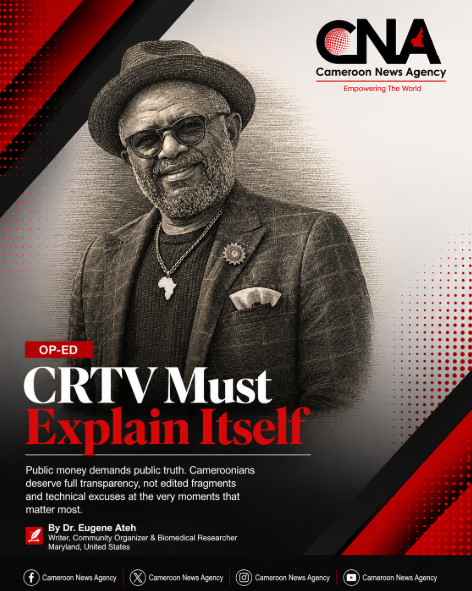
About Dr. Eugene Ateh
Dr. Eugene Ateh is a Cameroonian writer, community organizer and biomedical researcher based in Maryland, United States.
His writing centers on governance and public accountability, community development, diaspora engagement and faith-centered leadership, with a recurring focus on transparency in public institutions and the responsibilities that bind a state to its citizens.
Trained as a veterinary doctor (DVM, University of Ibadan), he spent years in biomedical research, including work on animal models and monoclonal-antibody development, before turning his energy toward community-building and civic advocacy on both sides of the Atlantic.
He writes for Cameroonian and diaspora audiences on the questions shaping his home country’s future, pairing a scientist’s respect for evidence with an organizer’s commitment to the common good.