Constitutional Court Upholds Sassou’s Election Victory
By Beri Wisbon,
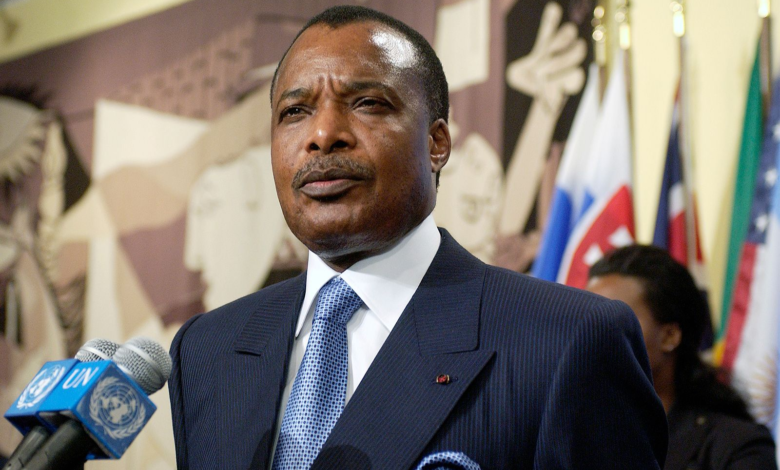
On March 28 Constitutional Court President Auguste Iloki proclaimed Candidate Denis Sassou Nguesso the winner of the March 15 polls with an absolute majority in the first round—94.90% of votes, up slightly from the 94.82% announced on March 17 as the preliminary result by Interior Minister Raymond Zephirin Mboulou.
The court’s ruling invalidates an appeal filed by two opposition candidates. According to Congo’s legislation, candidates, political parties, and voters may file a request to report major irregularities that could taint the vote. Ranked 3rd with 1.03% of votes cast, Dave Mafoula laid a complaint to the Constitutional Court on March 20, 2026, in Brazzaville, to denounce irregularities in the electoral process.
An effort that ultimately remained futile. The court’s ruling thus aligns with reports from the African Union Observer mission statement that confirmed the political maturity of the voting process in Congo, valorising the indicators of free, fair, and credible elections.
Beyond promises of economic development, the incumbent pledged during this new term to tackle corruption plaguing institutions by shifting from prevention to punishment. By stating that this time examples must be made, Denis Sassou Nguesso—in the view of many Congolese—sent a very strong message within his own camp. These results signal that the immediate priority for many Congolese voters remained peace, stability, and continuity.
The Constitutional Court’s proclamation of President Sassou’s re-election amplifies the scope of the nation’s diplomatic engagement. Sassou reiterated on election day that he would sustain ties with nations whose diplomacy is succinct and free of destabilization.
Notably, Russian Federation President Vladimir Putin was the first world leader to acknowledge President Sassou’s victory, a counterpart with whom he has maintained long-standing personal and professional relations. Recall that in 2025 alone, the leaders of Russia and the Congo met twice—in Moscow and Beijing—as part of celebrations marking the eightieth anniversary of the Victory in the Great Patriotic War and World War II.
Ties between Russia and the Republic of the Congo date back to the 1960s and have gained momentum in the 21st century in energy, security, and strategic diplomacy.
Now, a new era emerges in Congo-Brazzaville, embodying President Denis Sassou Nguesso’s philosophy from En Toute Transparence: 2021-2026. This mandate promises economic buoyancy, a clear political trajectory, people-centric policies, transparency and accountability, and sustainable growth.
Interconnected Stakes of the Election
President Sassou Nguesso’s fifth mandate provides a scope to set a clear agenda for the next five years amid ever-growing global changes.
A litmus test of political democracy and new indicators of elections, where the outcome is determined by both internal and external factors including sovereignty, public policy, diplomacy, foreign policy, and international alignments embedded in Congo’s National Agenda.