Jabi Katy Chale
At the recently concluded Our Ocean Conference (OOC), Cameroon took a seat at the global table, presenting aspects of some of its lived ocean realities, marine challenges, and ongoing conservation efforts. Central to these discussions were concerns surrounding fisheries sustainability and the blue economy.
During the conference, Cameroon was among the first countries to endorse the Mombasa Declaration and was also referenced for its contributions to the establishment of the Yaoundé Declaration on the Blue Economy in 2025, an initiative which contributed to the 11th OOC deliberations, and continues to shape regional ocean governance discussions.
“I was representing my ministry at the Eleventh Our Ocean Conference. We had a very important side event in which we participated, it was on transparency and IUU fishing. This issue of fighting against IUU fishing is very important in our country as we are under sanction from the European Union, and work has been undertaken as much as possible by the government to fight IUU fishing, and to implement transparency in fisheries. So, all these advancements that were made on this issue were supposed to be well known by the international community,” remarked Dr Mimbang Guy Irene, the First Technical Adviser at the Ministry of Livestock, Fisheries and Animal Industries.

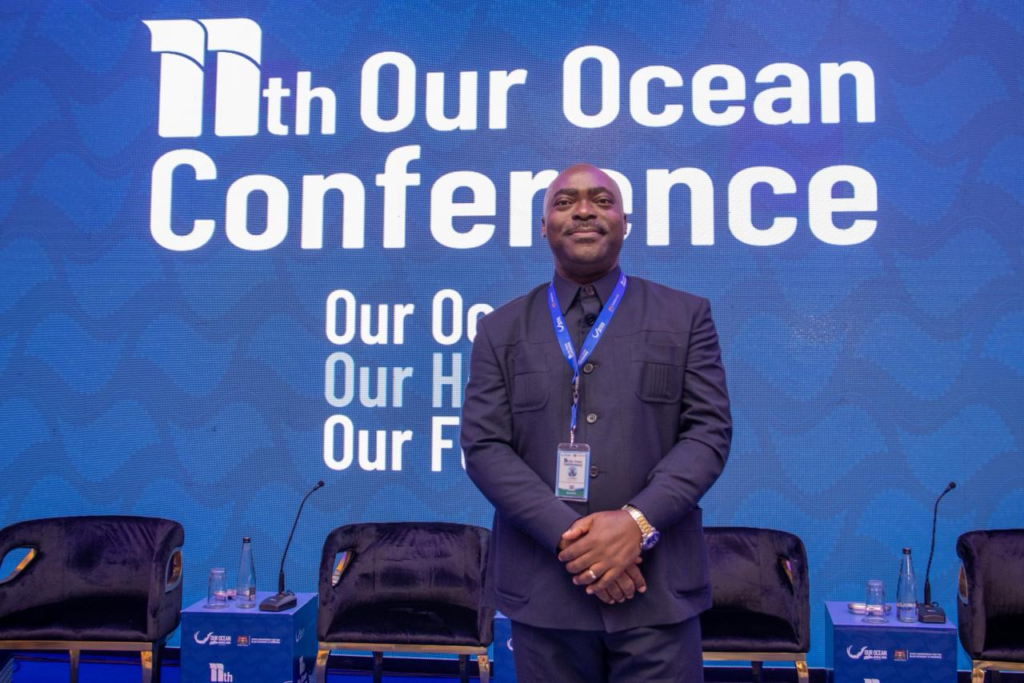
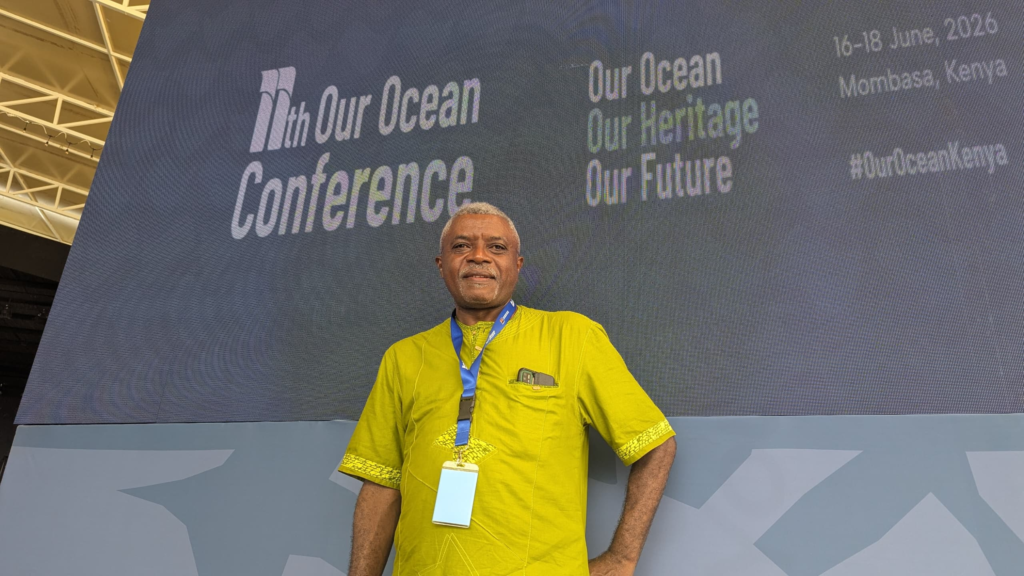
However, out of approximately 5,000 participants from over 100 countries, Cameroon News Agency (CNA) noted that only six individuals represented Cameroon specifically, amounting to about 0.12% representation. It should, however, be noted that other Cameroonians were present in different capacities through regional or international organizations, but were not representing Cameroon in particular.
Of the six identified participants, four were primarily engaged in fisheries sustainability. These included the First Technical Adviser at the Ministry of Livestock, Fisheries and Animal Industries; a staff member of Environmental Justice Foundation (EJF) Cameroon, who engaged in fisheries transparency, two members of the African Marine Mammal Conservation organization, who focused on IUU fishing, the 30×30 agenda, and the blue economy; and the President of Media for Fish and Animal Resources (MEFAR), who participated in discussions with the Gulf of Guinea Commission on the blue economy and reported on IUU fishing in his journalistic capacity. Additionally, a representative from the Center for Community Enhancement focused on plastic pollution, while a CNA correspondent covered the conference broadly.
Marine conservation in Cameroon spans several ministries. The Ministry of Environment, Nature Protection and Sustainable Development oversees marine biodiversity, marine protected areas (MPAs), marine pollution, coastal erosion, and international environmental conventions. The Ministry of Forestry and Wildlife manages coastal forests, while the Ministry of Livestock, Fisheries and Animal Industries is responsible for fisheries and aquaculture. The Ministry of Transport handles maritime transport, port operations, and shipping pollution, and the Ministry of Mines, Industry and Technological Development oversees river-to-sea impacts, hydropower-related activities, and water-for-energy projects. And also, the Cameroon Navy within the Ministry of Defence, for maritime security.
However, representation from several of these key ministries, particularly the Ministry of Environment, the lead institution for marine conservation, was reportedly absent. The Ministry of Fisheries was represented by only one delegate. Combined with the fact that most non-governmental participants focused primarily on fisheries sustainability, this raises the question: is fisheries sustainability the predominant marine challenge in Cameroon?
In January 2023, the European Union Commission issued a “red card” to Cameroon, banning fish exports due to weaknesses in monitoring and flagging vessels linked to illegal fishing activities.
In 2024, the United Arab Emirates also banned Cameroon-flagged vessels from its waters. Illegal, unreported and unregulated (IUU) fishing is estimated to cost the country about XAF 20 billion (approximately USD 33 million) annually, while the government spends an estimated XAF 102 billion (approximately USD 165 million) per year on fish imports. These pressures help explain the strong national and international focus on fisheries transparency and sustainability.
But Cameroon’s marine environment faces a wider range of challenges beyond fisheries.
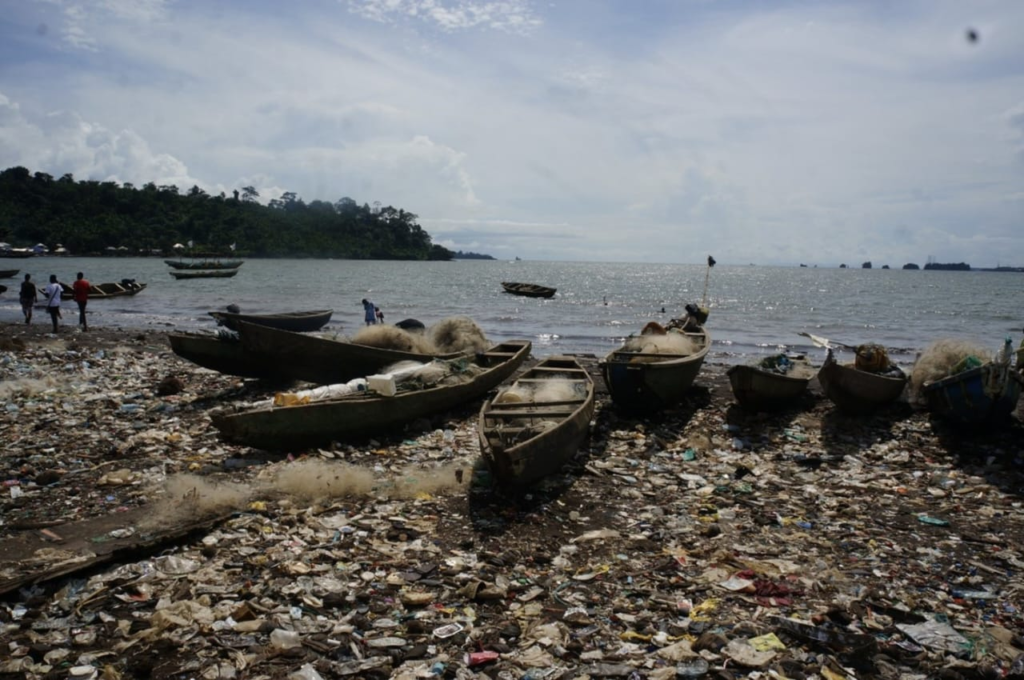
Plastic and marine debris pollution remains a persistent issue, particularly along coastal cities such as Limbe. According to the Ministry of Environment, Nature Protection and Sustainable Development, Cameroon generates approximately 600,000 tonnes of plastic waste annually, with over 10,000 tonnes entering the ocean each year. A 2023 quantitative study of the Limbe coastline by Esongami et al. recorded 12,822 plastic particles, with a mean abundance of 40.7% plastic items per square meter on sandy beaches.
Mangrove ecosystems have also experienced significant decline. Mangrove cover decreased from approximately 272,000 hectares in 1980 to 195,000 hectares in 2005, representing a 30% loss over 25 years. Similarly, wetland coverage in the Tiko–Douala coastal lowlands declined from 18% in 1996 to 12.1% in 2009, while more than 1,642 hectares of mangroves along the Fako coastline have been lost over the past three decades.
Maritime insecurity is another growing concern.
Cameroon remains excluded from certain regional oceanographic research initiatives, including aspects of the Dr. Fridtjof Nansen vessel programme, despite being a partner under the EAF-Nansen Programme since 2009. High maritime insecurity is among the contributing factors limiting the entry of this research vessel to Cameroon.
Coastal erosion and sea encroachment further threaten coastal communities, particularly in the Bakassi Peninsula. A geomorphological assessment revealed that land cover changes between 1978 and 2015 led to an increase in water bodies and island areas from 9.33 km² to 14.75 km². A 2021 study on Cameroon’s west coast recorded coastal erosion rates exceeding 100 meters annually in some areas, with approximately 3.90 mm of shoreline loss per year. Over 75% of the Wouri Estuary shoreline is retreating, while 88% of the southern shoreline, including Kribi, is experiencing significant land loss.
While these issues collectively fall under the broader blue economy framework, there is concern that integrating them into a single umbrella concept at such a high-level conference, may dilute their individual urgency and visibility.
According to Ngole Modecai, founder of the Center for Community Enhancement, timid participation from Cameroon contributed significantly to the imbalance in marine representation.

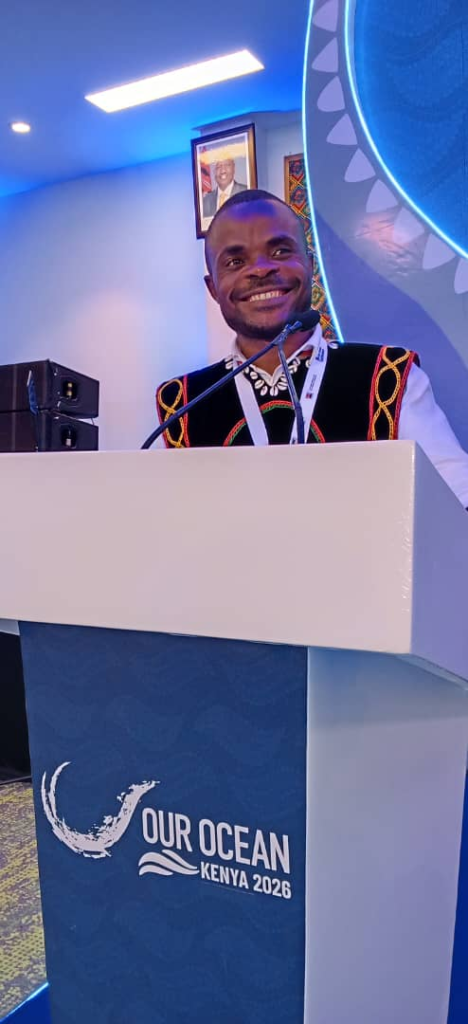
“The very limited number of participants was a major factor because the organizations that worked on mangroves and plastics were not there. So, I think that is another reason, we had very low participation, and that’s why the few people who came were representing their own work. I represented plastic pollution because that is the area I work in. If we had more people representing Cameroon, we would have had a more balanced representation. Personally, I was not very satisfied with Cameroon’s level of participation,” he said.

Reflecting on his experience, Modecai noted that global platforms such as the Our Ocean Conference offer critical opportunities for engagement with funders, partners, and stakeholders working on marine issues. He cautions that weak representation of some marine sectors at such international conferences, could lead to them being sidelined and receiving less international attention and funding.
“I participated in various activities. It gave me the opportunity to follow discussions and deliberations on these issues, connect with people working in the same field, share our experiences from Cameroon, exchange best practices, and learn from their approaches to tackling marine pollution,” he added.
For André Naoussi, President of Media for Fish and Animal Resources, Cameroon’s relatively low-level representation was a missed opportunity for stronger diplomatic and institutional engagement.
“It is always desirable to have a higher level of representation at conferences of this magnitude. When a country is not represented at a sufficiently high level, certain opportunities become inaccessible. At the closing ceremony, for example, delegates who are not ministers or senior officials follow the proceedings from the main hall, while ministers and high-ranking representatives attend in the principal conference room. These settings create opportunities to meet leaders, build partnerships, and advance national agendas,” he emphasized.

Is Cameroon’s limited representation and the strong focus on IUU fishing at the conference also a reflection of donor priorities; where funders pay less attention to Cameroon or primarily support IUU-related initiatives? Or does it point to insufficient visibility and projection by stakeholders in other marine sectors when opportunities such as these arise? And must logistical support for participation in such conferences always come from external sources, whether for government authorities or non-governmental stakeholders?
Both Ngole Modecai and André Naoussi express hope for more balanced and higher-level representation in future international marine engagements. This is particularly important given Cameroon’s 402 km coastline within the Gulf of Guinea, its rich and unique mangrove ecosystems, productive fisheries, major ports, offshore oil and gas resources, and its strategic role in regional ocean governance and conservation.
This story was realized thanks to the collaboration with www.communicationsinc.co.uk