Born from a Blackout: The Cameroonian AI Now Live in 54 African Countries — and the 700 Million Phones That Finally Have a Voice
A months-long CNA investigation into SkyDew, the platform built by Cameroonian innovator Zuo Bruno that delivers artificial intelligence over SMS and USSD — no internet, no smartphone, no app required. It is no longer a rumour. It is live.
A CNA investigation.
It began with silence.
For ninety-three days between January and April 2017, the English-speaking regions of Cameroon went dark. No WhatsApp. No email. No Google. No banking apps. No way to file a school assignment, send money to a sick mother, or tell a relative abroad you were still alive. The government had pulled the plug, and with it, the digital lifelines of nearly five million people. It remains, to this day, one of the longest internet shutdowns ever recorded on the African continent.
For most, it was an ordeal to be endured. For one young man, it was a question that would not let him sleep.
“If the internet can disappear for ninety-three days in my country, what does that say about every technology built on the assumption that it will always be there?”
That young man was Zuo Bruno. The question never left him. And nine years later, the answer has a name, a website, and a live presence in fifty-four African countries.
The answer is SkyDew.
THE AI GAP
700M+ Africans with a phone but no internet
3.8B People offline worldwide 0% Of them had access to AI — until now
Source: SkyDew (skydew.org); ITU offline-population estimates.
From Presidential Prize to Live Platform
In 2018, Zuo Bruno walked onto a stage and accepted a Presidential Prize for developing a vehicle tracking system that worked without internet connectivity — a technical feat that, in any other country, would have made him a household name overnight. In Cameroon, it made him something stranger: a quiet figure who, almost immediately afterward, seemed to vanish from public view.
He did not vanish. He was working.
CNA first picked up the trail in late 2023, when, in a brief and easily-missed remark during a small developer gathering, Bruno hinted that he was building “something for the people the internet forgot.” Pressed for details, he offered none. In the months that followed, this reporter spoke with former collaborators, technology observers, and engineers familiar with his earlier work.
What emerged from that quiet half-decade is now publicly verifiable at http://www.skydew.org
SkyDew is no longer a rumour, no longer a hint dropped at a developer meet-up. It is a live, operational platform serving real users across the continent today.
Its premise is as ambitious as it is heartbreaking.
SkyDew brings artificial intelligence to every African phone through SMS and USSD — no internet, no smartphone, no app needed. If you have a signal, you have AI. That is the platform’s own promise. And, as our investigation has confirmed, it works.
How a Farmer in Mali Talks to GPT-4
The mechanics are devastatingly simple — and that simplicity is the whole point.
A user finds a SkyDew number, often distributed by a local NGO, health worker, school or business. She sends an ordinary SMS, in her own language. On the other side of that message, SkyDew routes the query to one of the world’s most advanced AI models — OpenAI’s GPT-4o, Google’s Gemini, Anthropic’s Claude, DeepSeek, or Grok — then routes the answer back, also as ordinary SMS, in the same language she wrote in.
There is no app. There is no data plan. There is no smartphone. There is, in many cases, no electricity beyond the charge already in the phone.
Users who prefer it can dial a USSD shortcode — *123#, for example — and interact through a menu, the same way Africans across the continent have been topping up airtime and sending mobile money for two decades. On most networks, USSD is free.
The platform speaks more than one hundred languages. Swahili. Hausa. Amharic. Yoruba. Zulu. Twi. Wolof. Bambara. Igbo. Lingala. Kinyarwanda. Oromo. The list is longer than most outsiders imagine — and that, in a continent where AI has historically been delivered almost exclusively in English and French, may be the most quietly radical thing about it.
“If you have a phone and a signal, you have AI.”
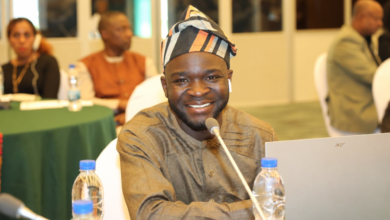
thr CEO, Bruno said.
The Forgotten 700 Million
The numbers, when you sit with them, are difficult to read.
More than 700 million Africans have a phone but no internet. Globally, 3.8 billion human beings live offline. Until SkyDew, none of them — not one — had access to the artificial intelligence revolution now reshaping the global economy.
A grandmother in a village outside Bamenda, Cameroon, treating a feverish grandchild with the same herbs her own grandmother used because the nearest clinic is hours away and there is no doctor to call. A cocoa farmer in the South-West, Cameroon, who cannot check the price his crop should command at market. A girl who has been pulled out of school not because she is unwilling to learn, but because there is nothing to learn from once the textbooks run out.
For each of them, the global conversation about AI has been a conversation happening in another room, in another language, behind a door they have no key to.
SkyDew is the key. And the key is already in the lock.
54 African Countries Where SkyDew is Live Today.
Source: skydew.org (verified by CNA, May 2026)
It Is Already Working.
CNA reviewed testimony and case material from organisations using SkyDew across the continent. The pattern is consistent and, in places, extraordinary.
In Kisumu, Kenya, a community health NGO uses SkyDew to deliver an SMS health bot that answers more than two hundred questions a day in Swahili — reaching patients who do not own smartphones but all of whom own phones. In rural Kenya, a separate health programme stood up an SMS bot serving forty thousand farmers within a week.
In Ségou, Mali, a smallholder farmer texts about diseased tomato leaves in Bambara and receives an AI diagnosis in seconds. “My phone has no internet,” he told one interviewer; the answer arrives anyway.
In Enugu, Nigeria, a secondary school student dials a USSD shortcode to ask mathematics questions. “Data costs too much,” she said, “but USSD is free on my network.” An AI explains, step by step.
In Kano, Nigeria, a microfinance operator built an AI loan assistant in Hausa over USSD; first-month adoption exceeded projections by a factor of three. In Accra, Ghana, a fintech founder built an SMS loan calculator for unbanked customers in two days; it now processes more than four hundred queries a week. In Kampala, Uganda, an EdTech startup turned a spare Android phone and a local SIM into a live AI tutoring service for students across three provinces — in three hours.
These are not pilots. These are deployments.
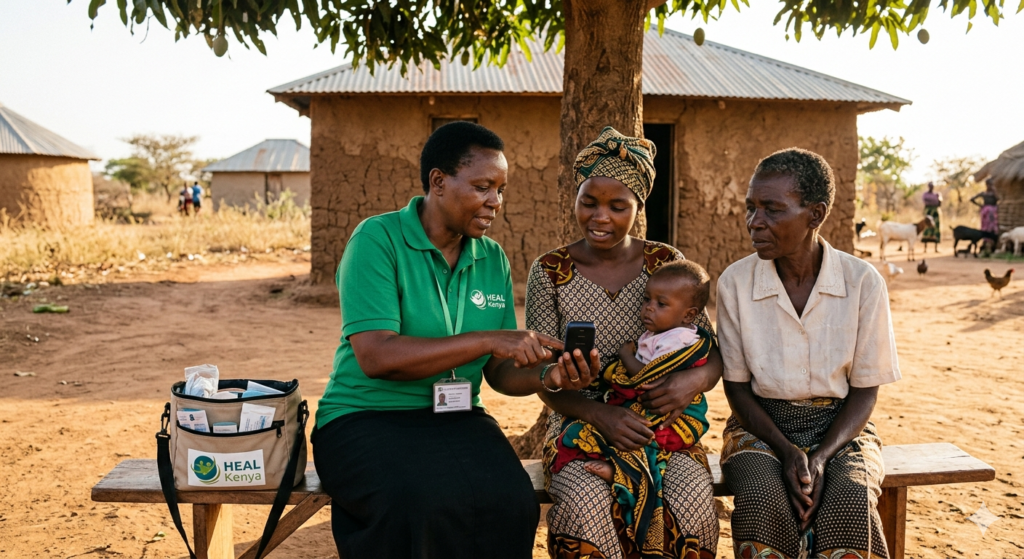
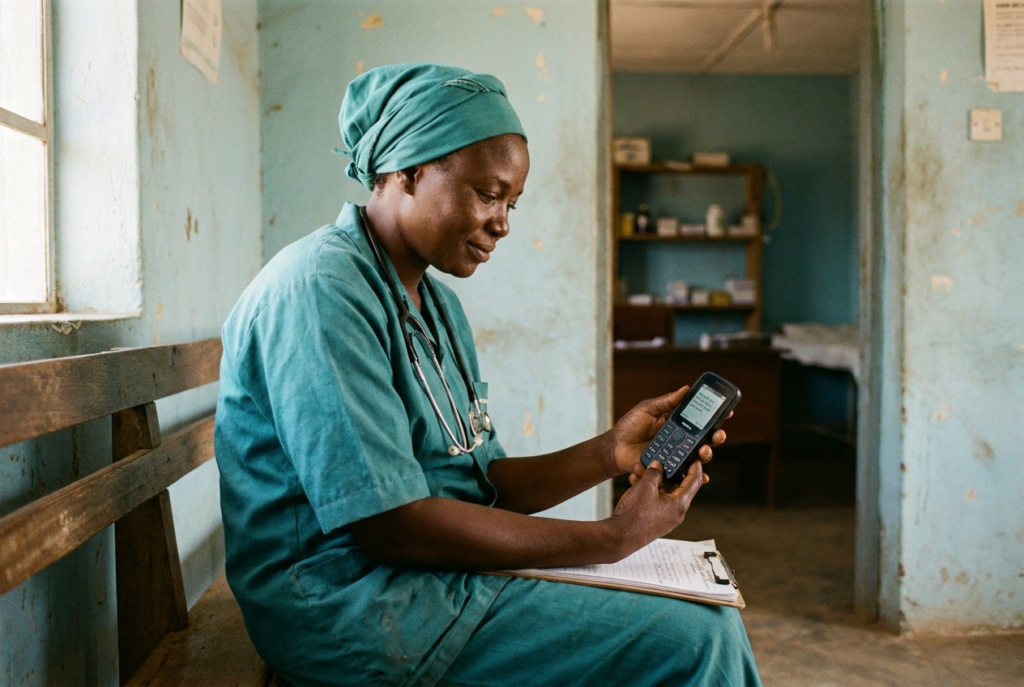
A community health worker using a basic phone with patients in a rural setting ( Illustration)
Where SkyDew is Delivering AI Today
Healthcare
Rural health workers in Kisumu, Kenya use SkyDew to deliver symptom checking, maternal care guidance and medication reminders over basic SMS — 200+ questions answered daily in Swahili.
Agriculture
A smallholder farmer in Ségou, Mali texts about diseased tomato leaves in Bambara and receives AI guidance in seconds — on a phone that has never seen the internet.
Education
A secondary school student in Enugu, Nigeria dials a USSD shortcode to ask maths questions. The AI explains step by step. Data costs too much — but USSD is free on her network.
Finance
A fintech founder in Accra, Ghana built an SMS loan calculator for unbanked customers in two days. It now processes 400+ queries a week — no app, just SMS.
The Wound That Built It
To understand SkyDew, one must return to those ninety-three days.
CNA spoke with several people who lived through the 2017 shutdown, most of whom asked that their full names be withheld. Their accounts share a common texture: a sense of being erased.
A teacher recalled standing in a queue for hours to use a borrowed connection across a regional border, just to send her students’ examination data. A small business owner described losing nearly everything as digital payments collapsed. A nurse remembered the helplessness of being unable to verify drug dosages she had previously looked up online without a second thought.
“It was as if someone had decided we did not exist. And we discovered that almost everything we depended on, depended on the internet. And the internet did not depend on us.”
— Resident of the North-West Region, Cameroon, 2017.
It is impossible to speak with people who lived through that period and not understand, in your bones, why a young engineer might decide that the next great technology of his lifetime should not be allowed to repeat that same dependency. Should not be allowed to forget anyone again.
That, perhaps, is the moral architecture beneath SkyDew’s technical one. It is also why SkyDew works on 2G — the network of last resort — and why it works through USSD, the most ancient and stubbornly available channel in mobile telephony. Bruno did not build for the future as Silicon Valley imagines it. He built for the present as four hundred and fifty million Africans actually live it.
SKYDEW — AT A GLANCE
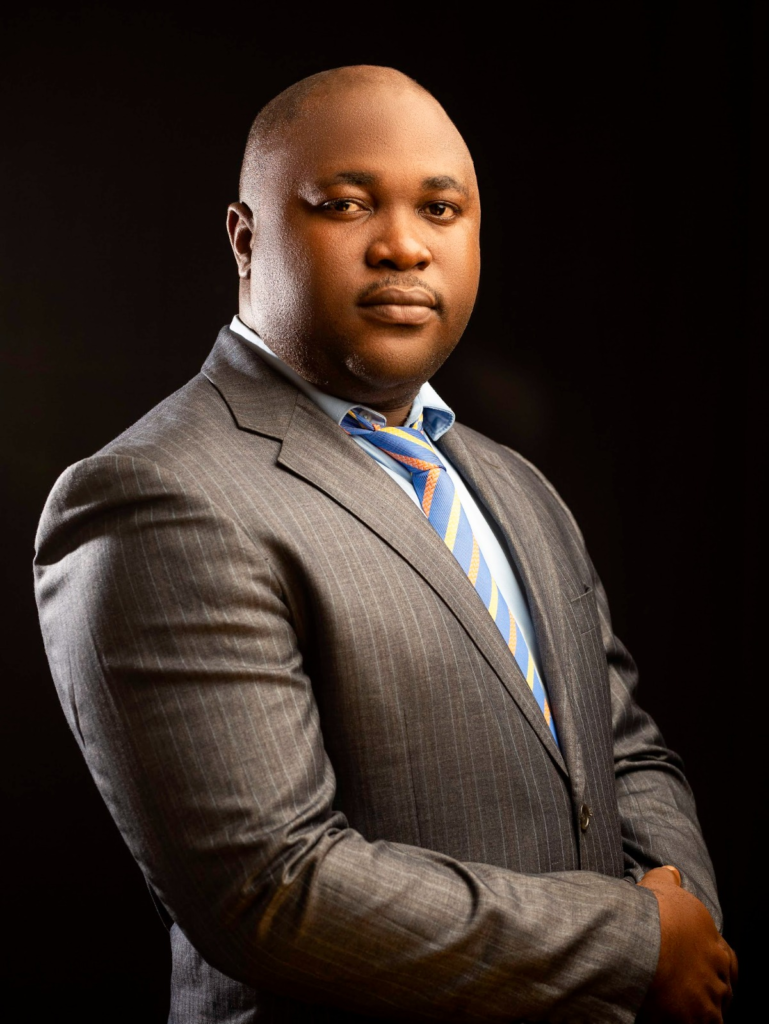
What it is. An AI communication platform that delivers GPT-4o, Gemini, Claude, DeepSeek and Grok over SMS and USSD — no internet, no smartphone, no app.
Founder. Zuo Bruno (Cameroon). Operated by Zuoix.
Where it works. Live across 54 African countries.
How users access it. Send an SMS or dial a USSD shortcode (e.g. *123#) on any basic handset.
Languages. 100+, including Swahili, Hausa, Amharic, Yoruba, Zulu, Twi, Wolof, Bambara, Igbo, Lingala, Kinyarwanda, Oromo and more.
Minimum network. 2G.
Sectors served. Healthcare, agriculture, education, financial services.
Status. Live. Operated commercially via skydew.org and skydew.org/business.
A Question Now Before the Nation
SkyDew is no longer a project in stealth. It is a live commercial platform, accepting sign-ups at http://www.skydew.org and onboarding institutional partners through skydew.org/business. NGOs, fintechs, EdTech startups, microfinance operators and health programmes are deploying on it today, in fifty-four countries.
Which raises questions Cameroon — and Africa — must now begin to answer.
Will the Cameroonian government invest in this innovation, or will it, like so many others before it, be forced to seek funding, talent, and ultimately a home elsewhere? History on this continent is littered with the names of brilliant minds whose work blossomed only after they boarded a plane. The Presidential Prize of 2018 was a beginning. It cannot be the end — not when the platform born of that recognition is now reaching seven hundred million people.
Will the public rally behind it? Public support — moral, civic, financial where possible — has historically been the difference between an African innovation that survives infancy and one that does not. SkyDew is past infancy. It is in the field. The question is whether Cameroonians will claim it as theirs before the rest of the world claims it first.
And will the African Union, the development partners, the philanthropic funders who speak so often of “bridging the digital divide,” recognise that the bridge is already standing — built in Cameroon, by a Cameroonian, for Cameroonians and the seven hundred million who share their condition?
A Final Reflection
There is something almost unbearably poetic about the origin of SkyDew. A government shutdown intended to silence a region instead planted the seed of a technology that now gives voice to a continent. A young man denied the tools of the modern world set about building tools that do not require the modern world to function — and, having built them, watched them spread to fifty-four countries before most of his own had heard of him.
SkyDew is no longer a question of whether it will succeed. It already has. The question now is what Cameroon, and Africa, will do with the fact of its success.
If we are honest, this is the quiet, devastating argument SkyDew makes simply by existing: the people most often described as “left behind” were never behind at all — only waiting for a technology humble enough to walk to where they already stood.
That technology has arrived. It is at skydew.org. And it is speaking, in a hundred languages, to a continent that the rest of the digital world forgot.
CNA will continue to follow this story.