
African civil society needs more than promises on paper
A new Forus report shows how laws, government rules, digital pressure, hostile narratives and donor practices can reinforce restrictions and what it would take to turn international commitments into meaningful protection and participation.
By Clarisse Sih and Bibbi Abruzzini, Forus
Ask a civil society leader in Africa what is making their work harder and you rarely get a single answer: a new law on registration, a donor that has withdrawn, a smear campaign on social media or a new surveillance rule. Each can be handled alone but taken together, they are something else.
In Morocco, a missing registration receipt can shut civil society organisations out of funding and open-government processes. Participants in a new Forus report described how authorities’ failure to issue final documents excluded active groups from opportunities vital to their work.
Latifa Soufiani of Espace Associatif, the Moroccan national platform, describes a gap between law and practice. Moroccan law requires authorities to issue a provisional receipt immediately and a definitive one within 60 days, yet some local authorities refuse files or never issue the documents. “The non-issuance of a definitive receipt can turn legal recognition into an effective obstacle to associative action,” she said.
In the Democratic Republic of the Congo and the Central African Republic, temporary registration papers can expire before official approval is completed. Donor due-diligence rules may then compound the problem by rejecting organisations that lack documents their governments have not supplied.
Restrictions that reinforce each other
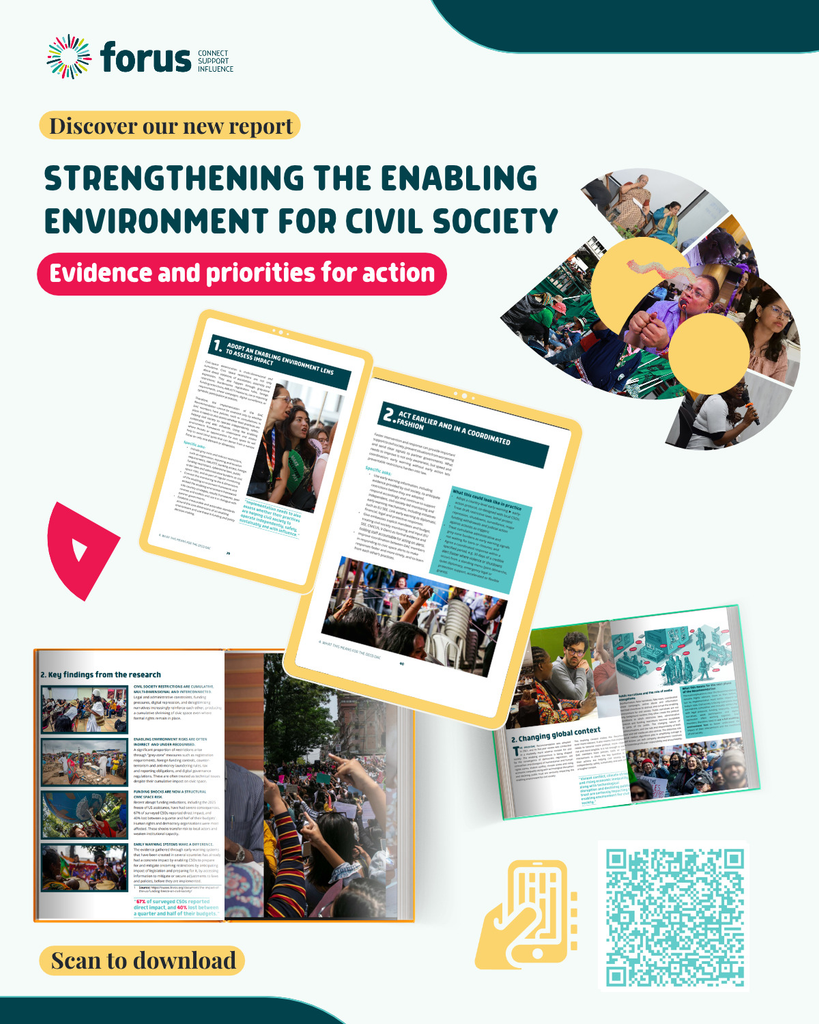
These cases feature in Forus Strengthening the Enabling Environment for Civil Society: Evidence and Priorities for Action, a global Forus report drawing on its network’s experience, bringing together 76 national NGO platforms and 8 regional civil society coalitions representing over 24,000 organisations around the globe, along with data from the European union System for an Enabling Environment for Civil Society (EU SEE), across 86 countries.
The cumulative shrinking of the enabling environment for civil society, even in places where formal rights remain in place, matters for how we read the continent. A country can protect association and expression on paper and still make it difficult for organisations to register, receive foreign funding, report to regulators or speak publicly without facing attacks on their legitimacy.
These pressures do not fall equally. Grassroots, women-led, youth-led and rights-focused organisations can face especially high barriers to protection, resources and participation.
Over time, administrative restrictions can become so embedded in everyday procedures that they are no longer recognised as restrictions at all. As one participant in the Forus consultations put it, “administrative restriction becomes normalised.” This is closely tied to funding: “Funding is part of the enabling-environment infrastructure and the current funding crisis is both financial and political.”
The “grey zone” of technical rules
This gradual erosion often takes place through what can be described as grey zone measures: registration requirements, foreign funding controls, counter-terrorism and anti-money laundering rules, tax and reporting obligations, and digital governance regulations. Often presented as technical or administrative matters, these measures attract less public attention and scrutiny than outright bans. Yet their cumulative impact can be considerable, progressively narrowing the space in which civil society organisations can operate, access resources and participate in public life.Such experiences point to a wider disconnect between the commitments made by governments and donors to protect civic space and the realities organisations face on the ground.
The gap between promises and practice
In 2021, members of the OECD’s Development Assistance Committee adopted a Recommendation on Enabling Civil Society in Development Co-operation and Humanitarian Assistance. Five years later, this standard remains highly relevant, but governments and donors have not kept pace with the realities facing civil society organisations.
There has been progress: dialogue spaces, flexible funding initiatives and monitoring tools, including the EU System for an Enabling Environment for Civil Society (EU SEE). Yet commitments are often more visible in policies and meetings than in reliable protection, quality funding or genuine influence. Ultimately, what matters is whether organisations can organise, speak, access resources and hold power to account.
As the analysis highlights, “the central implementation gap is about whether those actions are solid enough, timely, coherent and close enough to civil society realities.”
Donor decisions are part of the problem – and the solution
This gap is not only about restrictive governments. Donor decisions help determine which organisations survive and which issues remain fundable. Abrupt aid cuts, short-term grants and rigid compliance requirements can force groups to reduce advocacy and transfer risks onto local actors.
Abrupt funding cuts are a structural risk for the enabling environment for civil society. After the 2025 freeze of US assistance, 67% of surveyed organisations reported a direct impact and 40% lost between a quarter and a half of their budgets. Human rights and democracy organisations were most affected. Such shocks transfer risk to local actors and weaken their institutional capacity.
Locally led development is not simply a question of who receives the contract. Independent civil society must be able to set priorities, criticise decisions and work collectively. National NGO platforms and regional coalitions are vital to this, yet funding systems often overlook their role in connecting local voices with policymakers.
Chris Nkwatsibwe of the Uganda National NGO Forum (UNNGOF) cautions against treating the crisis as simply a matter of replacing lost funding. The question, he argued, is what kind of financing lets civil society stay independent in restrictive environments, including reserves, domestic resources and locally owned networks that are harder to dismiss as foreign-influenced. “We need to start examining what kind of civil society will emerge from this crisis,” he said.
Forus Co-Chair and Executive Director of the Uganda National NGO Forum Moses Isooba, made the point at the Aid Matters 2026 conference in Vienna: “Power moves when three things change: who decides, who holds the resources, and who defines success.”
His words point to a central challenge: shifting power also means recognising threats to civic space early and acting before they become embedded in laws, policies and administrative practice.
From early warnings to real action
Early-warning systems offer one way to do this. They can help organisations identify draft restrictions and sometimes secure changes before laws take effect. But the Forus report argues that warnings must trigger action from DAC members and the broader civil society support ecosystem: timely dialogue, coordinated diplomacy, legal and digital protection, and rapid flexible support – before restrictions become entrenched.
That also demands consistency across government. Development commitments lose force when security, anti-money laundering or digital rules elsewhere in the same administration make independent organising harder.
From commitment to capability
For donor governments, the challenge is to move from broad commitments to practical action: acting earlier when the enabling environment for civil society deteriorates, providing more predictable and flexible funding, reducing burdensome compliance, protecting digital space and making sure civil society participation actually influence decisions.
For Latifa Soufiani, the stakes go beyond individual organisations: “We are not only defending our own organisational interests. We are defending a broader principle: an administration that respects the law and citizens who enjoy equal rights when dealing with public services.”
African civil society is not asking for protection from scrutiny, it is asking for conditions in which it can plan, act independently and be heard – and to shape the decisions affecting their communities. The evidence in this report shows what DAC members can do to contribute.