The Collective Shield: West Africa Civil Society’s United Front Against Restrictions on Civic Space- Case of Togo and Senegal
By Nfor Hanson Nchanji
Preamble
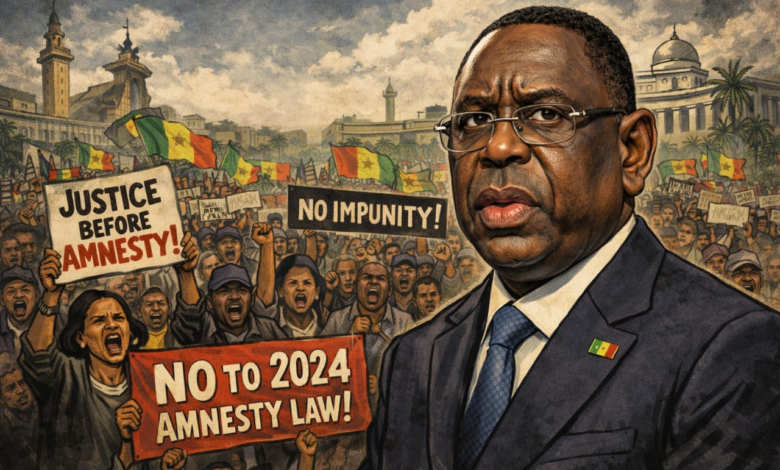
Senegalese capital, Dakar, often regarded as the symbol of West African democracy, was a shadow of itself when, in February 2024, the streets, once regarded as the safest place to run to, became a place where state machinery turned against civic space and citizens’ right to protest. Tear gas and water canons were used, and smoke filled the atmosphere as youths protested at Place de la Nation, against a February 3 decision by former president, Macky Sall, to postpone the country’s elections, plunging the nation into constitutional uncertainty.
As a means to stifle the civic space and instill fear among Sengalese, the gendarmes were unleashed on the population. Protests that broke out in the Zinguinchor area were immediately quashed while other cities burned into flames. At least three people died, media reports said, quoting a human rights organization like Amnesty International, which also reported that a hundred were arrested by the Macky regime.
In an attempt to shield itself and the responsibility of the security forces, the former President Macky Sall signed a controversial Amnesty Law, which rights organizations said was an affront to the victims of the protests. The law of March 6, 2024, granted amnesty for all acts related to the political protests between February 2021 and February 2024. But many critics said it was a “double-edged” sword law because, though it allowed the release of political prisoners like the now Prime Minister and President, Ousmane Sonko and Diomaye Faye, respectively, it blocked access to justice for victims of police brutality. After all, the law also shielded members of the security forces from being prosecuted for their role in the killings and torture of civilians. This was a denial of justice by the families and international bodies.
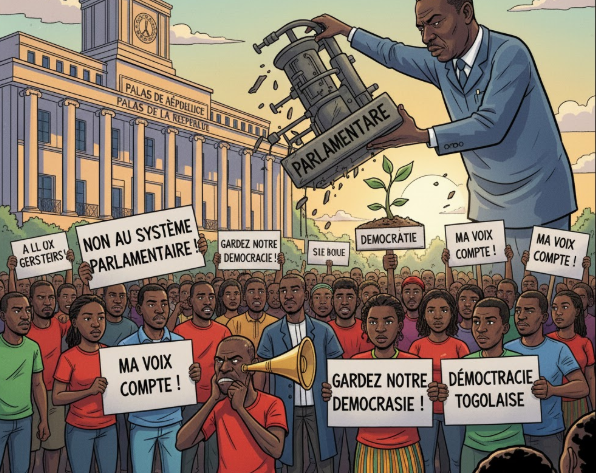
In Togo, there was a parallel constitutional maneuvering that did not need guns to be won. This came shortly after Senegal’s Amnesty Law was passed in March 2024. In April the same year, the Togolese Parliament adopted a new constitution that saw the shifting of the presidential system to a parliamentary system. A group of 17 civil society organizations described it as a constitutional coup. Under this new constitution, the president would no longer be elected through universal suffrage, as in the majority of countries in the world, but the parliament will be allowed to do so. This elimination of direct presidential elections, with more powers given to the Council of Ministers, was a slap in the face of Togolese who had yearned for change since the Gnassingbe family took over power in 1967.
The events in Togo and Senegal in 2024 show two different faces of the same crisis: the civic space is in dire need of being protected, and political dissent has become the number one enemy in these countries. At that point, Senegal, once the beacon of democracy in the West African subregion, reduced itself to a dictatorial state, showing how it used Amnesty to bury the past, while Togo used the constitutional amendment to control the future.
Crux of the Matter
Looking at the above events in Senegal and Togo, the lifespan of democratic participation by the Civil Society Organizations, CSOs, in these countries was threatened, pushing them to create a defense mechanism and a collective shield that moved the discussion from passive victimhood to active resistance. As the national democratic gains became fragile, there were several collective actions and cross-border solidarity of CSOs, which acted as the most effective defensive mechanism against efforts to restrict fundamental human rights of the people. West African CSOs have now understood that to protect civic space back home, they must rely on supernatural forces abroad. The fight did not end on the streets of Lome and Dakar; they took it to Addis Ababa and Abuja, transforming the regional bodies into arbiters of democratic accountability.
National Platforms and Fight for Civic Space
- FONGTO- Federation of NGOs in Togo
The Federation of Non-Governmental Organisations in Togo, FONGTO, was one of the key groups that pushed back against the government’s action during the 2024 constitutional crisis. They found themselves in a civic chokehold where their national actions were being monitored by the state as street protests were banned. They resorted to technocratic survival and defense by organising high-level capacity building workshops on the efficiency of the civic space. They made sure that even though they could not protest as dissent voices were silenced, their body shall continue to show testament that they indeed exist.
However, the national shield efforts hit a wall because they lacked legal standing, as, unlike their neighbor Benin, where the CSOs have the power to bring cases in front of the Constitutional Court, the law in Togo prevents NGOs and CSOs from challenging the constitutionality of new laws. But Civicus Lens reports that young people have continued to ask for change in Togo even though democracy is at the beck and call of the long-serving family of Gnassingbe. But what could they do? They can see the violations, but can never open the courtroom because they are being held back by laws made by the same people holding them back.
With this domestic pushback blocked and the streets under heavy military surveillance, the national shield was overcome in Togo, leaving very little room for CSOs to succeed, and this is one of the reasons why the struggle had to migrate to regional courts liek ECOWAS Court of Justice.
- CONGAD- Council of NGOs in Support of Development in Senegal
If Togolese CSOs encountered roadblocks due to government restrictions on political dissent during constitutional changes, their counterparts in Senegal faced a similar issue, though not as restricted as in Togo. CSOs in Senegal faced the “erase history issue” where events were being wiped out by the introduction of an Amnesty Law in April 2024 by the former President, Macky Sall.
CONGAD, the country’s NGO umbrella organisation that supports development, was forced into political trenches as it joined the massive ‘Aar Sunu Election’, which means “Protect Our Election” campaign. This NGO mobilized a huge network of actors to issue statements- this took them from their background of a technical support system to become frontline defenders of human rights and democracy, using their weight to mount pressure on the government.
Malick Ndome, Consultant, Senior Policy Advisor, and Board Member of CONGAD, said, “The adoption of the March 2024 Amnesty Law has profoundly reshaped the operating space of Senegalese civil society, particularly in its ability to advocate for victims of political violence that occurred between 2021 and 2024 and to maintain pressure for accountability. According to the positions commonly expressed by CONGAD, the most significant impact of this law lies in the elimination of national judicial avenues for establishing responsibility.
By neutralizing ongoing prosecutions and closing off the possibility of initiating new ones, the amnesty creates a legal void that deprives victims and their families of credible prospects for justice. It also fosters a climate of self-censorship within organizations, which see their capacity for critical advocacy reduced due to associated political and institutional risks.”
He warns that this law contributed to the partial delegitimization of the role of CSOs, who are often called upon by the population to manage expectations and frustrations of victims without having appropriate institutional tools.
But something interesting about CONGAD was that they did not fold their arms in the challenges of such magnitude. Malick confirmed that they adopted a common agenda throughout the nation, “Faced with this restrictive environment, CSOs adopted a collective action strategy organized around regional networks, exemplified by the ‘Collective Shield’ approach. This dynamic made it possible to bypass national limitations by relying on alliances with human rights defense platforms in Togo, Ghana, Benin, and Nigeria.” Malick Ndome revealed.
The United Front of West Africa’s Civil Society was the main reason why the partnerships opened alternative avenues for documenting cases, initiating actions with regional bodies — notably the ECOWAS Court of Justice and the African Commission — and mobilizing diplomacies less exposed to internal political tensions. They say unity is strength, and this was demonstrated by the numerous actions taken and the role played by ECOWAS and WACSI.
Cross-border Actions
- Role of ECOWAS
The Economic Community of West African States, ECOWAS, played a vital role in de-legitimizing the Amnesty Law in Senegal, although it did not completely stop it. ECOWAS was used as a Regional Escape Route, whereby the CSOs from Senegal used to reclaim justice. This means the collective shield is not only a defensive mechanism, but it also has an offensive tool that bridges the gap between impunity and resilience in Senegal. The ECOWAS ruling was on both sides. While the political wing struggled to maintain a peaceful Senegal with mediation and dialogue, the Court of Justice stripped the law of its moral and legal legitimacy on the global stage. This sent a strong message that national laws cannot override fundamental human rights.
It also meant that CSOs in Senegal were able to take the battle overseas, obtaining a powerful legal weapon that they can now boast of and cite as precedent to pressure subsequent administrations or escalate cases to other international bodies, such as the UN Human Rights Council. The victory also showed how the combined efforts of the Senegalese Activists provided evidence to regional lawyers who provided expertise, while other coalitions provided funding and visibility, can push an agenda to regional success.
- WACSI’s Efforts
The West African Civil Society Institute, WASCI, played a vital role in transitioning from being a training body to an operational hub for CSOs in Senegal and Togo. They made sure that the national crackdown did not totally isolate the CSOs. The Ghana-based Institute acted as a regional amplifier in 2024 when Togolose government moved to a parliamentary system. WASCI leveraged its observer status at the ECOWAS Commission to highlight that the constitutional change had violated ECOWAS protocol on democracy and good governance, which does not allow for substantial changes to electoral laws shortly before elections.
WASCI also gave technical support to FONGTO, to enable them document parliament violations. The documentation was later used to brief international human rights bodies shortly after local protests were banned.
In Senegal, WASCI coordinated and supervised a network of human rights lawyers to support the biggest CSOs, CONGAD, and other partner groups, by exploring intra-national justice. They framed the Amnesty Law of 2024 as a violation of international treaties on the right to truth and justice. WASCI is said to have also maintained a Regional Situation Room throughout 2024 to solve cases that were coming from Togo and Senegal. It used this platform to issue Regional Alerts, thereby preventing the governments from describing the context as internal matters.
A positive future
In 2024, WASCI and ECOWAS served as connecting tissues to the West African democracy. When national laws in Togo and Senegal sought to bury the truth and silence dissent, the two bodies provided the legal, digital, and diplomatic infrastructure to enable regional action and reaction to events taking place in the national context. This united front against restrictions on civic space has become a regional concern and no longer a national issue. Together, they rose as one region, different branches but the same objective- building a collective shield to protect themselves and foster good governance.
The three lessons that can be transferred to other contexts are the collective shield strategy, regionalisation of civic defense, and the building of infrastructure, which should have digital, legal, and diplomatic approaches.
“This article is written as part of the Forus journalism fellowship programme. Learn more here“