By Hans Ngala
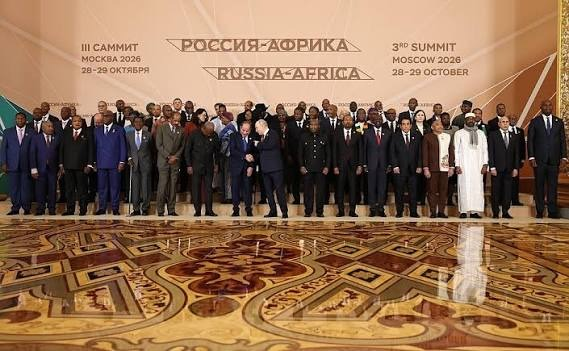
The third Russia-Africa Summit has ended with only two African countries telling Moscow to stop the recruitment of their citizens into the Russian army. The two-day event from October 28 to 29 in Moscow brought together over 30 African leaders, with just 22 African presidents in attendance – a drop from the 43 who initially attended the first summit in 2019.
During this year’s summit where the leaders met with Russia’s Vladimir Putin, Ghana and Kenya lobbied for Russia to stop recruiting their citizens into the Russian army to fight against Ukraine.
Following an in-person meeting between Putin and Ghana’s president, John Mahama on the sidelines of the summit, Ghana’s foreign affairs minister, Sam Okudzeto Ablakwa announced on X that “Following concerns raised by President Mahama, President Putin has declared that Ghanaians are no longer allowed to participate in the war with Ukraine. This policy applies to all circumstances whether through irregular recruitments or expression of voluntary interests”.
The engagement with Putin also included Russia providing scholarships for Ghanaian students, building a power plant in Ghana and an arms deal where Russia will supply Ghana’s army with weapons.
The Cameroonian delegation to the event was headed by Cameroon’s external relations minister, Lejeune Mbella Mbella. Mbella in his routine diplomacy, read a long speech at the event and reaffirmed Cameroon’s bilateral relationship with Russia, but fell short of asking Moscow to desist from recruiting Cameroonians into Russia’s army to fight against Ukraine. This, despite Cameroonians being the most-killed citizens in Russia’s aggression against Ukraine.
According to Dr. Emmanuel Epongo, a Cameroonian scholar based in South Africa: “President Vladimir Putin is a shrewd and calculating politician whose objective is to drive a wedge between African leaders and the West, particularly the United States” Epongo said after following the summit last week. He added that: “At a time when the United States and other Western countries are supporting Ukraine against Russian aggression, Putin seeks to weaken Africa’s political and diplomatic ties with the West while expanding Russia’s geopolitical influence in Africa and to exploit the continent’s natural resources. Unfortunately, many African leaders and citizens are falling into this trap, mistaking Russia’s geopolitical ambitions for genuine friendship and a commitment to Africa’s development”.
Epongo’s views are shared by Dibussi Tande, a Cameroonian writer and political analyst who says “There is no surprise about the Cameroonian delegation being tepid and measured in what they told Putin. Cameroon stands to gain more from Russia and if that means sacrificing some of their citizens, they don’t mind” Tande said.
In February 2026, INPACT, a Swiss consortium of investigative journalists released a list of those killed on the frontlines in Ukraine, with Cameroonians constituting the largest number of deaths from Africa. CNA has documented some of those Cameroonian deaths, including Onana Moise (39); Brice Dongmo (35); Mainimo Franklin (33) and Nges Didymus (35) both in our reporting and a documentary we released in May this year titled “The Cameroonians Dying in Russia’s War”.
Our reporting has identified economics as the main driving force behind Cameroonians joining the Russian army. There is no evidence that people are joining for any ideological reasons or anti-Ukraine reasons as even Ukraine’s foreign minister admitted to the BBC that Ukraine also recruits foreigners into her army but does so within the provisions of international law which Russia often disregards.
Last week’s Russia-Africa Summit was clearly a case of Russia using Africa as a pawn in its anti-West rhetoric as the country continues its war against Ukraine. Putin told leaders at the opening of the summit that the West is still trying to exploit Africa’s resources and uses debt to hold back its development: “Africa is increasingly asserting itself as one of the key players in the global economy and politics” Putin told the room full of African leaders.
“However, the emergence of a multipolar world is, of course, no easy task; it faces resistance from countries that are not prepared to accept this reality: those who are accustomed to thinking in terms of their colonial past and to enriching themselves fabulously” he added.
Following the end of the summit and the silence of the Cameroonian delegation on the continued deaths of Cameroonians on the frontlines in Ukraine, Prof Victor Julius Ngoh, a Cameroonian historian and political analyst told CNA “I am not surprised at all by their silence. I believe strongly that there’s an unwitting understanding between Russia and Cameroon” Ngoh said, “Cameroonian officials are not unaware of these Cameroonian deaths in Ukraine, but the Ministry of External Relations, Ministry of Defense and the Ministry of Communication have not even mentioned this officially, that Cameroonians are going to fight for Russia and in a subtle way, government wants this to go on”.