International Day of Persons With Disabilities: We Must Not Forget Them
By Hans Ngala
According to Cameroon’s Nkafu Policy Institute, some one million Cameroonians live with various disabilities. Often, their needs are not considered when the government enacts policies or when institutions/organizations such as schools, churches, and even some hospitals are built. Very few of our institutions are disability-friendly, and this is not right.
The October 12 presidential election was one key reminder of just how persons with disability tend to be sidelined in discussions around issues of national interest. Princely Njukang, a journalist living with visual impairment, wrote a piece for us here at CNA, pleading with authorities to see to it that those like him, with visual impairment, should be remembered as the country goes to vote. In the end, he had his voting rights stripped away as an ELECAM official had to go into the voting booth in order to help him vote, a move which not only jeopardizes the electoral process but also his own privacy as a legally upright Cameroonian.
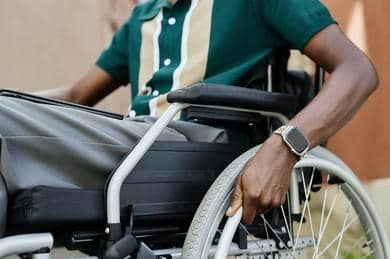
The United Nations saw the need for a more disability-inclusive world and mandated every December 3 since 1992 as International Day of Persons With Disabilities. More than a billion people live with various types of disabilities globally. This means persons with disabilities are not just a fringe group, but a core part of the world’s population. The majority of them live in Global South countries, including Cameroon. Most of them often cannot afford the tools that are supposed to make their daily lives better: wheelchairs, hearing aids, crutches, etc because very often, these are expensive and require regular maintenance.
However, we have seen cases of persons with disabilities who have risen above their circumstances to lead very successful lives. Some gifted writers have lost their power of speech, journalists who broadcast while sitting in a wheelchair, doctors who don’t see quite well, and all this is to confirm that with the right tools and environment, people with disabilities can live to their fullest potential too.
The CBC Health Services, through its Socio-Economic Empowerment of Persons With Disabilities Program (SEEPD) has been one of the leading crusaders for the rights of persons with disabilities in Cameroon, advocating for their rights and providing seed capital to some of them to run various businesses.
Mainstreaming persons with disabilities is not merely an act of charity; it is a moral, social, and economic imperative that would transform Cameroon into a more just and equitable society. When we design policies, public spaces and institutions with the full inclusion of persons with disabilities in mind, we expand opportunities for everyone. Accessibility measures like ramps, tactile walkways, sign-language interpretation, accessible ICTs, and inclusive education benefit not only those with disabilities but also older persons, pregnant women, children and even able-bodied citizens navigating a difficult environment.
Cameroon’s progress has long been hindered by the tendency to treat disability as an afterthought or, worse still, as a curse or misfortune. Such beliefs have fueled stigma, discrimination, and social exclusion for decades. In some Cameroonian communities, families still hide children with disabilities out of shame or fear of ridicule. This mindset must change. Disabilities are not deficiencies of character; they are part of the diversity of the human experience. And when society recognizes this, it shifts from pity to empowerment — from seeing persons with disabilities as dependents to acknowledging them as capable contributors to national development.
In practical terms, mainstreaming disability demands a collective effort involving government, civil society, the private sector, faith communities, and individual citizens. Biya’s government must strengthen and enforce legislation protecting the rights of persons with disabilities while ensuring that public buildings, transportation systems and communication channels meet accessibility standards for those with disabilities. Schools must embrace inclusive education rather than pushing learners with disabilities to separate or inferior tracks. Employers must commit to creating supportive workplaces and providing reasonable accommodation. Faith communities, which shape so much of Cameroon’s social attitudes, must actively challenge harmful stereotypes and champion acceptance and dignity.
Ultimately, the work of building an inclusive Cameroon cannot be left to disability organizations alone. Every Cameroonian has a role to play in creating a country where no one is left behind. When persons with disabilities can move freely, access opportunities, participate in public life and contribute their talents without barriers, the entire society becomes stronger, fairer and more resilient. An inclusive Cameroon is not only possible — it is necessary.