Douala: Abandoned Waste Sparks Open Burning and Health Concerns
By Synthia Lateu
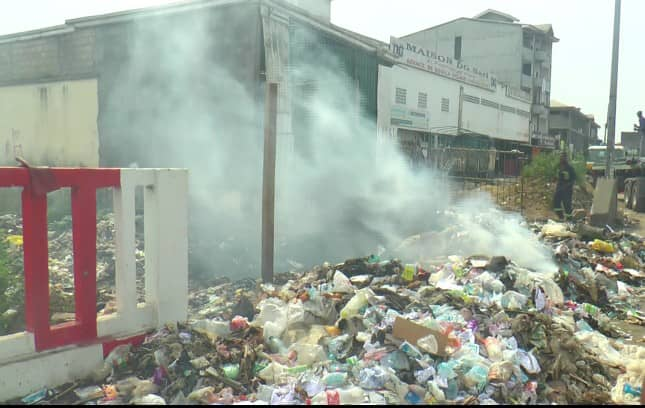
In several neighbourhoods of Douala, Cameroon’s economic capital, thick smoke now regularly rises from burning piles of household waste, exposing residents to toxic fumes and raising concerns about public health and environmental safety.
In Entrée Bille, in Douala III subdivision, plastic and organic waste is often set alight along roadsides. Similar scenes can be found across the city, where gaps in waste collection have pushed some residents to resort to open burning.
Douala produces around 2,700 tonnes of household waste daily, according to official figures, but only 1,800 tonnes are collected, leaving large quantities to accumulate in residential areas.
Residents say rubbish bins are insufficient or poorly distributed, particularly in densely populated neighbourhoods.
“The waste dirties the city and the smell is suffocating, especially when dumps are close to restaurants,” said Dieudonné Foefack, a resident of Douala.
Others say the situation has worsened in recent years.
“Every few steps you encounter waste. It has become uncomfortable to live in the city,” said Royal Martial, another resident.
While some residents burn waste to reduce its volume, others oppose the practice, citing health risks.
“The smoke intoxicates the whole neighbourhood. We should wait for the waste collection company to remove it,” said Joseph Tioko.
Health and Environmental Risks
Environmental experts warn that burning household waste releases highly toxic substances into the air.
Ecologist Didier Yimkoua says open waste burning emits carcinogenic gases such as dioxins and furans, which can damage the respiratory system and eyes.
“The ashes contain heavy metals that contaminate the soil. During rainfall, these pollutants are washed into waterways and eventually reach the sea, where they contaminate fish and pose serious public health risks,” he said.
Water contamination is a growing concern. Environmental experts say runoff from burnt waste carries heavy metals and toxic residues into rivers, drains and coastal waters. These pollutants can enter the food chain through fish and seafood, increasing the risk of waterborne diseases, particularly during the rainy season and periods of flooding.
Environmental journalist Mathias Mouende Ngamo adds that the practice contributes to climate change and threatens food security.
“Greenhouse gas emissions from waste burning accelerate global warming, while soil and water pollution affect agriculture and aquatic life,” he said.
Medical doctor Aristide Ngangnia warns that waste accumulation and burning also promote the spread of disease-carrying vectors such as flies and insects, increasing the risk of illnesses including typhoid fever, tetanus and malaria.
Fire Hazards
Fire services in Douala say uncontrolled waste burning has become increasingly frequent.
Captain Kouamo Deumegni Fabrice, commander of the city’s 201st Fire Brigade, urged residents to avoid lighting fires.
“When waste is burned without control, it can quickly turn into a fire hazard for nearby homes and the environment,” he said, advising residents to alert sanitation services instead.
Calls for Reform
Environmentalists argue that Cameroon’s waste management system is outdated and overly reliant on collection and disposal, with little emphasis on recycling.
“Burning household waste must be prohibited. Waste should be treated as a resource,” said Ngamo, citing recycling of plastics, paper and organic waste as sustainable alternatives.
Yimkoua says recycling remains the only long-term solution.
“Without a shift towards recycling, the household waste problem will persist,” he said.
Government Response
Authorities have acknowledged the scale of the challenge.
On 21 January, Cameroon’s Minister of Territorial Administration, Paul Atanga Nji, announced tougher measures against indiscriminate waste disposal, warning that offenders could face prosecution.
He said local councils would identify official waste collection points and that divisional and sub-divisional officers, alongside mayors, would conduct weekly inspections to ensure compliance.
Experts say effective enforcement must also address poor household waste sorting, weaknesses in pre-collection systems and the exclusion of informal waste workers, who play a significant role in urban sanitation