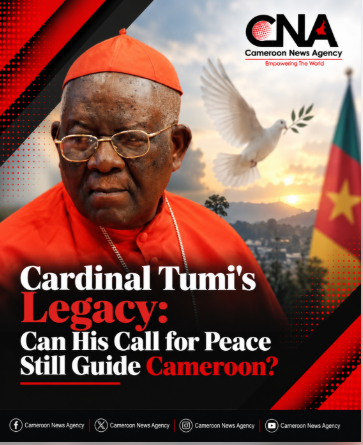
Five years after his death, a memorial day declared by the Fon of Nso is bringing renewed attention to the late cardinal’s message of dialogue, justice and reconciliation and the challenge of turning those principles into action.
When the Fon of Nso, Sehm Mbinglo I, met the Archbishop of Douala, Samuel Kleda, this week, their conversation carried significance beyond a meeting between a traditional ruler and a church leader. It brought renewed attention to the legacy of Christian Cardinal Wiyghan Tumi, whose final years were marked by efforts to find a peaceful solution to Anglophone crisis.
The Fon has declared Sunday, October 25, 2026, Cardinal Tumi Tribute Day, calling for prayers for the late cardinal and for lasting peace, justice and reconciliation in Cameroon. The observance follows community engagements in Douala and a dialogue intended to promote unity among members of the Nso community. Churches and Muslim faithful have also been invited to participate in prayers.
But beyond the memorial, the occasion raises a question that remains difficult for Cameroon: can the ideas Cardinal Tumi championed help guide a country still searching for a lasting resolution to its conflict?
A cardinal who insisted on dialogue
Born in Kikaikelaki, near Kumbo, in the North West Region, Tumi became Cameroon’s first cardinal when Pope John Paul II elevated him to the College of Cardinals in 1988. He later served as Archbishop of Douala before retiring in 2009. He died on April 3, 2021, aged 90.
His public role extended beyond the Catholic Church. He spoke openly about governance, corruption, democracy and human rights, and became an advocate for dialogue as the Anglophone crisis deepened.
In 2019, Tumi announced a nationwide peace initiative for the conflict-affected North West and South West regions. He warned that the crisis could not be resolved through religious declarations or condemnation alone, insisting that peace required concrete action on the ground.
That distinction remains central to his legacy. Tumi did not present peace as simply the absence of fighting. His efforts included engaging communities, gathering views on the causes of the crisis and advocating a broader conference where Anglophones could discuss their grievances and possible solutions.
The proposed Anglophone General Conference did not take place as envisaged. Nevertheless, the effort reflected his conviction that a conflict rooted in political, historical and cultural grievances required more than security measures or calls for unity.
When peace advocacy carried risks
Tumi’s commitment to dialogue was tested in November 2020, when he and the Fon of Nso were abducted by armed separatists while travelling in the North West Region. Tumi was released after spending a night with his captors.
During the encounter, he made clear that he did not speak for the government and would criticise wrongdoing regardless of who committed it. His position reflected the independence he believed religious leaders should maintain when addressing injustice.
The episode also illustrated the risks facing people who attempt to create space for dialogue amid armed conflict. Tumi’s advocacy did not shield him from threats or detention, but he continued to argue for a peaceful settlement.
Pope Francis, in a message following his death, praised Tumi’s defence of democracy and promotion of human rights, describing the mark he left on the Church and Cameroon’s social and political life as unforgettable.
From remembrance to practical action
The Fon’s decision to dedicate October 25 to Tumi’s memory offers an opportunity to revisit the cardinal’s message. Yet memorials can only do so much if the values being celebrated are not translated into sustained efforts.
For communities affected by the Anglophone conflict, the questions remain practical: how can trust be rebuilt between divided communities?
Tumi’s approach suggests that peace initiatives must engage with the grievances and experiences of affected people, rather than rely on declarations made far from them. It also places responsibility on leaders to be prepared to listen, acknowledge wrongdoing and pursue solutions that extend beyond immediate political interests.
That does not mean dialogue alone can resolve every disagreement. Any meaningful peace process would need to address security concerns, accountability, the protection of civilians and the political questions at the heart of the conflict. Tumi’s legacy offers a framework for reflection, not a ready-made solution.
A legacy that asks something of the living
The meeting between the Fon of Nso and Archbishop Kleda, and the declaration of a memorial day, have brought Tumi’s name back into public conversation. The tribute also carries a personal dimension: the Fon and the cardinal shared the experience of abduction in 2020, and Tumi had supported the Fon’s return to the Nso Palace.
For the Nso community, the memorial honours one of its most prominent sons. For the Catholic Church, it recalls a leader who linked faith with public responsibility. For Cameroon more broadly, it raises the question of whether the values he defended can influence efforts to overcome division.
As Cameroon remembers Cardinal Tumi on October 25, his call for peace remains a challenge to the living: not simply to speak about reconciliation, but to demonstrate what it requires.