By Synthia Lateu
Banana prices are rising in local markets across Cameroon, even as the country records strong export growth. In January 2026, Cameroon exported 27,674 tonnes of bananas, a 27.39% increase compared to January 2025, marking the sector’s best monthly performance in 16 years, according to industry figures.
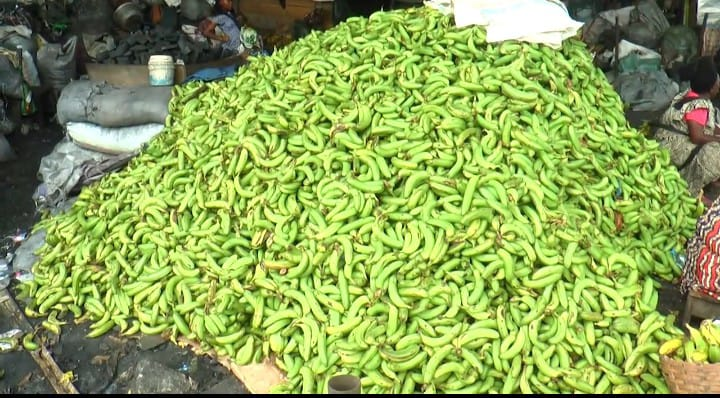
Despite this export boom, households say bananas are becoming increasingly unaffordable. At the banana section of Dakar Market, prices have doubled. Five fingers of plantain now sell for 200 francs CFA, compared to 100 francs previously, and only a few bunches remain available.
Martine Ikassi, a buyer, says the rising prices are making it difficult for families to rely on bananas as a staple food.
“We used to buy seven fingers for 100 francs, but today I only bought five for 200 francs. There is no money. Everything is expensive, and banana which we could rely on is also expensive. I wanted to cook it for my children.”
Another customer, Philip, says even with a higher budget, buying enough bananas has become difficult.
“I have gone round the market and there is no way. Banana is too expensive. Even with 1,500 francs, we cannot eat it satisfactorily anymore,” he said.
He adds that in the past, 2,000 francs was enough to cook a pot of banana for the household, but that is no longer the case.
Among vendors, both wholesalers and retailers say prices fluctuate daily depending on supply from farmers and the quality of bananas delivered to the market.
Vendor Wandji Dorrette says demand from foreign buyers can also influence prices.
“It depends on arrivals. Sometimes if Chadians do not buy much, or if there are problems with trucks transporting the bananas, we have plenty here and prices fall.”
Some vendors question why a country that produces bananas locally is experiencing such high prices.
“We cultivate bananas here in this country, but we still suffer. We don’t know where they all go,” one vendor said.
Others say the bananas sold locally are often those not suitable for export.
“These are bananas that cannot travel abroad. In the past, they were sometimes thrown away. Now they are sold here, yet they are still expensive.” A vendor said.
Economist Jean Marie Biada says the gap between rising exports and high domestic prices is largely structural.
According to him, more than 95 percent of bananas produced by agro-industrial farms are exported, leaving the local market dependent on small-scale farmers.
“Local plantations are generally small. Most farmers cultivate less than two hectares and combine bananas with other crops,” he explains.
Biada also notes that the government has not established quotas requiring large producers to supply part of their production to the domestic market.
“The government has defined any quota to those industrial farmers to bound them to supply the local market with their production whereas the necessary production inputs came from Cameroon , Man power , salt, labour expertise and transportation” he said.
To stabilize prices, the economist suggests introducing production quotas for the local market and supporting the creation of large-scale farms run by Cameroonian investors.
“The government don’t have to feel ashamed to create what I’m calling local industrial capital.
So the government gives you round capitals. We have also human resources here , labour , Man power and the government can also give collatorates for some international donors to grant create an industrial farm rules by Cameroonians”
Bananas remain one of Cameroon’s top ten non-oil exports, generating 36.6 billion CFA francs from 243,428 tonnes exported in 2024, according to the National Institute of Statistics.
Meanwhile, as exports grow, many households say the once affordable staple is gradually disappearing from their tables.