By Hans Ngala
Before 2025 came to an end, the West Africa region was once again in the spotlight. On October 12, Cameroonians voted in an election which many had hoped would unseat 92-year-old Paul Biya. Election results were proclaimed on October 27, declaring Biya as winner and sparking violent protests, mainly in the economic hub of Douala and in the northern regions where Biya’s main opponent, Issa Tchiroma comes from. In the immediate aftermath, Biya made adjustments within the ranks of the military, likely fearing a coup which has become all too common in West African countries. While Biya claimed victory, so did his opponent Issa Tchiroma. Tchiroma had served under Biya as a minister for over 20 years and announced a surprise resignation in June 2025. While a coup never happened in Cameroon, talk of it was prevalent as a coup in Madagascar toppled Andry Rajoelina in September – a month before Cameroon’s presidential election.
In Nigeria, Africa’s largest democracy with over 200 million people, President Bola Tinubu announced the replacement of top military officials after rumours of a coup plot in late October.
On November 26, senior military officer in Guinea-Bissau overthrew President Umaro Sissoco Embaló. This came just hours before the country’s electoral commission was due to announce the results of the country’s presidential election. The commission said results could not be announced nor certified because the military had destroyed ballot papers. Embaló fled to Senegal and the military maintains control of the country.
Weeks later, soldiers in Benin appeared on national television and announced that they had seized power from President Patrice Talon. However, hours later, forces loyal to President Talon announced that the coup had been foiled and those behind it arrested. ECOWAS forces were swiftly deployed to Benin and are credited with helping maintain democracy in the country.
In Guinea-Conakry, Gen. Mamady Doumbouya was declared the winner of Guinea’s presidential election on December 31. Elections were held on December 28 after Doumbouya, like Biya in Cameroon, had barred opposition heavyweights from being on the ballot. Doumbouya was announced by Guinea-Conakry’s electoral commission as winner with a little over 86 percent of the votes. His runner-up had just 6.59 percent.
“It is a paradox that West Africa which is the subregion with the most countries with functional democracies, is also the most coup-prone” Franklin Sone Bayen a renowned Cameroonian journalist and writer on international affairs told CNA. Bayen added that “Of the 16 West African countries there, only two – Senegal and Cape Verde – have never known military coups. Others have known many. It is also the subregion with the most stringent rules against military takeovers under ECOWAS. The circumstance leading to coups may have changed from basic bread and butter or mere quest for power between the 1960s and 1990s, to more sophisticated geopolitics and pan-Africanist enlightenment and awareness over the value and control of national natural resources” the seasoned journalist clarified.
Factors accounting for the coups are varied and unique in the case of each country, but overall, their frequency demonstrates an erosion of trust in democratic institutions and principles.
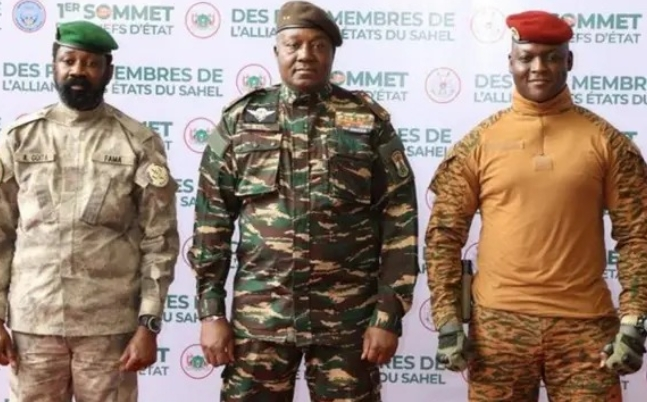
While a country like Burkina Faso, under the military leadership of Ibrahim Traore – is seen as a charismatic leader by a younger generation of Africans – some are skeptical of Traore. His alignment with China and Russia makes Western institutions and governments uncomfortable, not just because of his socialist principles but his open castigation of the West. And while it is true that Russia plays a role in propping up military rule in Burkina Faso, Mali and Niger, there are urgent questions that need to be asked. What led these countries to turn to Russia in the first place? The West (particularly France) was present in these countries for decades and has seen its relationship sour with both ordinary citizens and these countries’ leaders. But why? Could it be that the West caused (at least partially), these countries to turn to Russia and China, even inadvertently?
Images of a Niamey football stadium packed with 30,000 Nigeriens in August 2023, waving Russian flags and chanting pro-Russian slogans are still vivid in the minds of many. The massive crowd came to send a message to the West: that they stand with Russia. This can hardly be dismissed simply as Russian propaganda but should serve as a moment of deep reflection for the West to re-examine how it relates with African states. This is clearly not the 1950s or 1960s any longer, when a paternalistic and colonial approach to an Africa-West relationship could always work in the favour of the West. A new generation of Africans that is more self-aware, more globally connected, digitally-savvy and highly educated is now realizing that African realities are uniquely different from those of the West and that in a globalized world, this may mean working with non-Western partners to achieve their own political and developmental goals.
A case in point is the US invasion of Venezuela. In what the Trump administration dubbed as “Operation Absolute Resolve”, Venezuelan President, Nicolas Maduro was captured by US special forces in the early hours of January 3, 2026. Months in planning, it was executed with such surgical precision that it has left analysts wondering if someone on the inside helped the US. Africans reading this from afar see the West’s strongest, richest and most forceful proponent of “democracy” as a hypocrite in this moment. The US has some of the strongest democratic institutions in the world and its presidential elections remain one of the most (if not the most) transparent in the world. But violating the sovereignty of a country just because its leader was considered a dictator who was close to countries like Russia and China whom the US does not like, makes African states to worry. It weakens US credibility in Africa and drives coup-prone countries even further into the orbit of Russia and China. This is exacerbated when the fact that the US government a year ago, announced a severance of aid packages around the world. African countries were some of the hardest-hit and with little to gain from the US, these African countries will find themselves drawn even more to Russia and China which readily cut deals with them and often have little regard for human rights or democracy – an advantage the US and its Western allies had maintained for decades in Africa and around the world.
As Western influence wanes amid a shifting global geopolitical landscape and at a time when democracy is needed more than ever before – the approach needs to change. In the end, reversing the tide of coups in Africa will require a dual responsibility: Africans reclaiming democratic accountability from within, and Western partners fundamentally rethinking how they engage the continent. For African states, the starting point is restoring trust in institutions. This means credible elections, term limits that are respected, independent courts, and professional, apolitical militaries whose loyalty is to constitutions rather than individuals. Coups thrive where citizens feel locked out of political change; where the youth are unemployed, civic voices are stiled and corruption is normalized – a reality in West and Central African states where coups are too common. Regional bodies such as the African Union must also act consistently, condemning both unconstitutional seizures of power and constitutional manipulation by civilian leaders that hollow out democracy from within – instead of rushing to congratulate leaders even when the masses are protesting the veracity of election results.
For Western partners, lectures and sanctions alone are no longer sufficient, and often, they are counterproductive. Africa’s new generation is acutely aware of double standards—support for democracy in principle, selective silence in practice, and interventions that violate sovereignty when strategic interests are threatened. A more credible partnership would prioritize long-term institution-building over personalities, align security cooperation with democratic benchmarks, and engage African societies, not just governments. Crucially, Africa must be treated as an equal geopolitical actor, not a battleground for rival powers. Only through mutual accountability, and genuine partnership can democracy be defended—and coups rendered unnecessary and illegitimate in Africa’s evolving political landscape.