A Bridge Over Troubled Waters: Why the Papal Visit is Anglophone’s Last Best Hope for Peace, Justice
By Nfor Hanson Nchanji
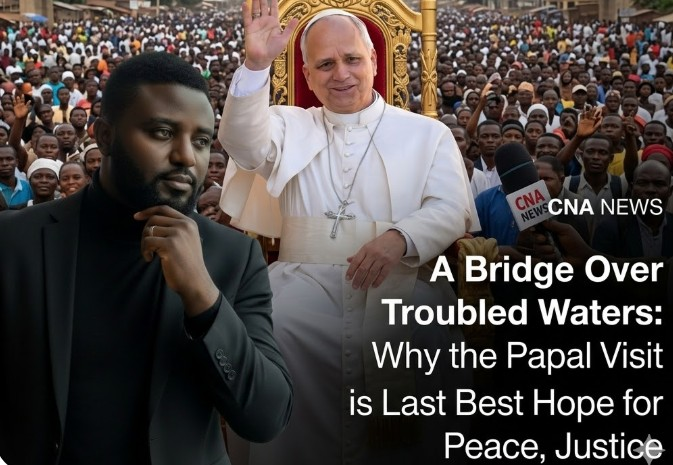
LIMBE, Cameroon- As the Swiss Guard and Vatican Gendarmes finalize security protocols from the hills of Mvolyé to the wind-swept airport in Bamenda, Cameroonians are holding their breath. The arrival of Pope Leo XIV on April 15 is not merely a religious milestone; for a nation fractured by 10 years of the Anglophone Conflict, it is a high-stakes diplomatic intervention.
In the streets of Buea and Bamenda, the expectation is palpable. While the government in Yaoundé prepares a red-carpet welcome, the victims of the conflict in the North West and South West regions are looking for something more substantial than ceremony. They are looking for Justice.
“We don’t just want a blessing; we want a witness,” says a local civil society activist. “We want the Holy Father to see the scars on our land and the hollow eyes of our displaced children.”
Pope Leo XIV, the first American-born Pope, has already signaled that his first African tour will focus on “wounded nations.” By choosing to step foot in Bamenda, the epicenter of the separatist conflict, he is breaking the “diplomacy of silence.” This visit serves as a powerful reminder that there can be no reconciliation without an honest confrontation with the truth of our shared suffering. But will Yaounde heed the Pope’s call for meaningful dialogue, reconciliation, and justice with the Anglophone?
While a sense of normalcy prevails in Yaoundé, the nation’s political capital is buzzing with preparation. President Paul Biya, a devout Catholic, is reportedly planning a sumptuous reception for Pope Leo XIV—the spiritual leader of his own faith. Yet, beyond the diplomatic protocols and gold-leafed halls, the true weight of this visit lies in whether the President is ready to heed the Pope’s counsel regarding the protracted conflict in the North-West and South-West (NWSW) regions.
The Last, Best Hope
For many Anglophones, the arrival of the Sovereign Pontiff represents the “last, best hope” for peace. What began as a strike by lawyers and teachers demanding institutional reform in 2016 quickly spiraled into a secessionist conflict fueled by decades of systemic neglect. The people originally protested for the basics: functional roads, clean water, and reliable electricity. Instead, leaders like Mancho Bibixy were arrested and remain behind bars to this day.
In a striking irony, the government is currently racing to pave the very roads in Bamenda that citizens once begged for. This sudden infrastructure push on the eve of the Papal visit underscores a hard truth: the Pope’s presence is currently the only leverage the people have. Anglophones are looking to the Vatican; a body long viewed as the only mediator capable of bringing Yaoundé to a table of genuine, unconditional dialogue, to break the cycle of failed international mediation.
However, the path to reconciliation is blocked by the gates of Kondengui and other detention centers. Thousands remain incarcerated; some were arrested with evidence, while many others were framed or simply caught in the wrong place at the wrong time. True reconciliation is impossible while these individuals languish in cells.
All eyes are now on President Biya. Will he grant a significant act of presidential clemency? For the “Nera 10,” who were extrajudicially repatriated from Abuja in 2018, and for the countless others awaiting justice, the Pope’s message is more than a sermon; it is a plea for the restoration of confidence, justice, and the release of those whose only crime was demanding a better life.
What Anglophones Want to Hear During the Papal Visit
A Definitive Call for a Ceasefire: An immediate and monitored end to hostilities from both the military and armed separatist groups to allow for humanitarian corridors.
The “Vatican Mediation” Commitment: A public pledge that the Holy See will act as the chief mediator in a True National Dialogue, hosted on neutral ground without pre-conditions.
A Truth and Reconciliation Commission: The establishment of an independent body—vetted by international observers—to investigate human rights abuses and provide a platform for victims to be heard.
General Amnesty and Safe Return: A broad legal amnesty for all Anglophones in the diaspora, IDPs and those currently in the “bushes,” ensuring they can return to their communities without fear of arrest or reprisal.
Release of All Political Prisoners: The unconditional release of those detained in connection with the crisis since 2016, including the “Nera 10,” Mancho Bibixy, and thousands of others held in Kondengui and various detention centers.
Constitutional Reform: Recognition of the “Root Causes”, specifically a return to a governance model (such as a Federation or quasi Autonomy) that restores the legal, educational, and cultural identity of the Anglophone regions.
Demilitarization of Civilian Areas: The withdrawal of heavy military presence from residential neighborhoods and schools in the North-West and South-West to restore a sense of daily peace.
End to the “School Boycott” Cycle: A moral appeal for the total protection of education, ensuring that schools are no longer used as bargaining chips or battlegrounds.
Justice for Slain Clergy and Civilians: A demand for credible, transparent investigations into the deaths of priests, religious figures, and thousands of innocent civilians whose cases have been swept under the rug.
Economic Reconstruction Fund: The announcement of a dedicated, internationally managed fund to rebuild destroyed villages, hospitals, and markets in the NWSW. This should have nothing to do with the Presidential Reconstruction plan that is being managed by the Minister Delegate to the Minister of Economy, Planning and Regional Development.